

⤴️-Paid Ad- Check advertising disclaimer here. Add your banner here.🔥
All Activity
- Past hour
-
Welcome to Indo-Investasi.com. Please feel free to browse around and get to know the others. If you have any questions please don't hesitate to ask.
- Today
-
 alistair7682 joined the community
 -
 Jean Luc Groschard reacted to a post in a topic:
Timingsolution & Nifty Updates - 3
Jean Luc Groschard reacted to a post in a topic:
Timingsolution & Nifty Updates - 3
-
 sahajpal joined the community
 -
Welcome to Indo-Investasi.com. Please feel free to browse around and get to know the others. If you have any questions please don't hesitate to ask.
-
Welcome to Indo-Investasi.com. Please feel free to browse around and get to know the others. If you have any questions please don't hesitate to ask.
-
 renekovacgu joined the community
 -
 Khaldeen247 joined the community
 -

HFMarkets (hfm.com): Market analysis services.
AllForexnews replied to AllForexnews's topic in Fundamental Analysis
[B]Date: 15th June 2026.[/B] [B]Oil Slides and Stocks Gain as US-Iran Deal Boosts Risk Appetite.[/B] The market turns risk-on as the US reaches a temporary deal with Iran to reopen the Strait of Hormuz. The deal ends all hostilities and will see the Strait allow shipping through from the 19 June onwards. Market risk appetite was quick to significantly rise at the opening of the Asian Session on Monday. The key price movement that all investors were hoping to see was the decline in oil prices. All energy-based products fell with a large price gap. However, the key movement was Crude oil which fell more than 5% and Brent oil, which fell 4.45%. This had a key impact on the US Dollar, Gold, and the stock market. Crude Oil Fall to 3-Month Low On Trump’s 80th birthday, the White House announced the peace deal which markets had long been awaiting. Crude oil was already falling last week, and fresh selling pressure is now pushing prices to a three-month low. The US and Iran are expected to sign the agreement on Friday, allowing for the reopening of the Strait. According to the White House, authorities will use the following four days to clear mines from the shipping route and restore safe passage through the strait. 20% of the world’s oil exports pass through the straits, but according to reports, this figure will fall to 15% from now onwards. In addition to this, the strain on supply is likely to remain for a minimum of 12 months. For this reason, investors do not expect the price of Crude Oil to fall to $55 per barrel. However, traders expect prices to fall further in the coming weeks, provided geopolitical tensions do not escalate again. In the medium term, price action indicates a potential decline to $74.95 per barrel, which was the price on the day the US and Israel struck Iran. However, economists advise that, for inflation to decline, oil prices must fall below $70 per barrel at a minimum. NASDAQ - SpaceX Rises The US stock market saw significant gains during this morning’s Asian session on the news of the deal being reached with Iran. In addition to this, the NASDAQ was particularly in demand due to SpaceX’s positive performance on Friday and during this morning’s pre-market trading. HFM - NASDAQ 30-Minute Chart The NASDAQ is obtaining key bullish signals from multiple tools and indicators. All global indices are trading higher this morning, while the VIX falls more than 5%. In addition to this, the put-call ratio falls below its two-month high, while bond yields fall by 40 basis points. All these factors support the NASDAQ, which is witnessing 85% of its components rising this morning. A key factor for the NASDAQ to continue performing well is for inflation to come under pressure and the Federal Reserve’s policy to remain neutral. The Chicago exchange rate expectations now sees the chance of a pause at 46%, up from 28% a week ago. If the possibility of a pause rises, the NASDAQ may find further support. Lastly, SpaceX began trading on the Nasdaq on 12 June 2026, but is not yet a component of the NASDAQ 100. Nasdaq recently changed its rules to allow very large IPOs to enter the Nasdaq-100 after as little as 15 trading days, instead of waiting several months. Many analysts expect the stock to be added in the near future. Space Exploration Technologies Corp rose 19% on its first day of trading and has also risen a further 5% during this morning’s Asian session. Gold and the US Dollar The US Dollar is under pressure as diplomatic efforts between Washington and Tehran make significant progress. The US Dollar is this morning’s worst-performing currency. Investor sentiment improved after US President Donald Trump reportedly cancelled planned strikes on Iranian infrastructure, and thereafter confirmed that an agreement had been made. The proposed deal would reportedly secure the reopening of key shipping routes through the strategically important Strait of Hormuz. It would also include Iran’s commitment to abandon its nuclear weapons ambitions. For financial markets, these developments reduced concerns over a broader regional conflict and potential disruptions to global energy supplies. As geopolitical risks eased, investors reduced their demand for the US Dollar, triggering profit-taking and contributing to the currency’s decline. However, this saw Gold rebound as investors took advantage of the weakening Dollar and Gold’s low entry levels. HFM - Gold 15-Minute Chart Key Takeaway: Markets turned risk-on after the US and Iran agreed to reopen the Strait of Hormuz and end hostilities. Oil prices fell sharply, with Crude oil dropping more than 5% and Brent oil declining 4.45%, easing concerns over energy supply disruptions. The NASDAQ rallied, supported by lower volatility, falling bond yields, improving Fed pause expectations, and strong gains in SpaceX shares. The US Dollar weakened significantly as investors reduced safe-haven positions following the diplomatic breakthrough. Gold rebounded from recent lows, benefiting from the weaker Dollar despite improving market sentiment. [B]Always trade with strict risk management. Your capital is the single most important aspect of your trading business.[/B] [B]Please note that times displayed based on local time zone and are from time of writing this report.[/B] Click [URL='https://www.hfm.com/hf/en/trading-tools/economic-calendar.html'][B]HERE[/B][/URL] to access the full HFM Economic calendar. Want to learn to trade and analyse the markets? Join our webinars and get analysis and trading ideas combined with better understanding of how markets work. Click [URL='https://www.hfm.com/en/trading-tools/trading-webinars.html'][B]HERE[/B][/URL] to register for FREE! [URL='https://analysis.hfm.com/'][B]Click HERE to READ more Market news.[/B][/URL] [B]Michalis Efthymiou HFMarkets[/B] [B]Disclaimer:[/B] This material is provided as a general marketing communication for information purposes only and does not constitute an independent investment research. Nothing in this communication contains, or should be considered as containing, an investment advice or an investment recommendation or a solicitation for the purpose of buying or selling of any financial instrument. All information provided is gathered from reputable sources and any information containing an indication of past performance is not a guarantee or reliable indicator of future performance. Users acknowledge that any investment in Leveraged Products is characterized by a certain degree of uncertainty and that any investment of this nature involves a high level of risk for which the users are solely responsible and liable. We assume no liability for any loss arising from any investment made based on the information provided in this communication. This communication must not be reproduced or further distributed without our prior written permission. -
 MADFUN joined the community
 -
 bluecap joined the community
 -
 Banner1 joined the community
 -
 shitsaar joined the community
 -
Welcome to Indo-Investasi.com. Please feel free to browse around and get to know the others. If you have any questions please don't hesitate to ask.
- Yesterday
-
 Abdulhamid krayz joined the community
 -
Welcome to Indo-Investasi.com. Please feel free to browse around and get to know the others. If you have any questions please don't hesitate to ask.
-
 khiladi786 joined the community
 - Last week
-
Welcome to Indo-Investasi.com. Please feel free to browse around and get to know the others. If you have any questions please don't hesitate to ask.
-
 Hello, Quick announcement: 1. All the resources in the forums have been moved inside the vault, which is accessible only after you log in to the community. You can access the vault here. 2. Also in the vault, you can request ebooks, materials, and downloads only in specific requirements sections. 3. You can share materials only inside THE VAULT. Do not post materials in other categories, outside the vault, as those are for discussions only. 4. Please do not share materials that are under copyright. Also, we will maintain a Do Not Share list where users can request that their materials not be shared If you have any questions, please post them here!
-
- 3
-
-

-
HFMarkets (hfm.com): Market analysis services.
AllForexnews replied to AllForexnews's topic in Fundamental Analysis
[B]Date: 12th June 2026.[/B] [B]Stock Market Today: Global Stocks Rally as Oil Prices Fall and SpaceX IPO Takes Centre Stage.[/B] Global markets surged on Friday as hopes of a diplomatic breakthrough between the United States and Iran boosted investor sentiment, driving stocks higher while oil prices retreated from recent highs. Meanwhile, traders are closely watching the highly anticipated debut of SpaceX, which is set to become the largest IPO in history. The combination of easing geopolitical tensions, falling energy prices, and renewed appetite for risk assets has created a strong risk-on environment across global financial markets. Global Stock Markets Rise on Iran Ceasefire Hopes Investor confidence improved significantly after US President Donald Trump announced that planned military strikes against Iran had been cancelled and suggested that a broader peace agreement could be finalised within days. Although Iran has yet to confirm a final agreement, markets reacted positively to signs that diplomatic efforts may be gaining momentum after months of conflict that disrupted energy markets and fuelled inflation concerns. Asian equity markets posted strong gains: South Korea’s KOSPI surged 7.8% Japan's Nikkei 225 gained 3.5% Hong Kong’s Hang Seng Index rose 1.8% China’s Shanghai Composite advanced 1.6% Australia’s ASX 200 climbed 1.9% S&P 500 rose 1.8% Dow Jones Industrial Average rose +1.9% Nasdaq Composite rose +2.5% Technology stocks led the rally, with investors returning to AI-related companies after recent volatility. Notable movers included Samsung Electronics, which gained more than 11%, SK Hynix, which rose over 7%, and Tokyo Electron, which jumped more than 10%. US markets also enjoyed a strong session, with all three major indices posting their largest daily gains in months. The rally reflected growing optimism that lower oil prices could ease inflationary pressures and reduce the likelihood of further monetary tightening. The technology sector remained in focus, with investors balancing excitement over artificial intelligence growth against concerns that elevated valuations may be creating speculative excess. Why Are Oil Prices Falling? Oil prices extended losses after reports that diplomatic discussions between Washington and Tehran had progressed, reducing fears of an immediate escalation in the Middle East conflict. Brent crude fell toward $89 per barrel, while U.S. West Texas Intermediate (WTI) crude traded near $86 per barrel. The decline comes despite ongoing uncertainty surrounding the Strait of Hormuz, one of the world's most important energy shipping routes. Roughly 20% of global oil and liquefied natural gas shipments typically pass through the strait, making any disruption a major concern for global energy markets. While markets have welcomed signs of progress, analysts continue to caution that any ceasefire agreement could remain fragile. Should negotiations collapse or supply disruptions persist, oil prices could quickly move higher again, potentially reigniting inflation concerns across major economies. Lower Oil Prices Ease Inflation Concerns Falling energy prices have helped reduce market expectations for additional interest rate increases from the Federal Reserve. Treasury yields moved lower as investors reassessed inflation risks: U.S. 2-Year Treasury Yield: 4.07% U.S. 10-Year Treasury Yield: 4.47% Market pricing for another Federal Reserve rate hike later this year also declined, reflecting growing confidence that lower oil prices could support the disinflation process. For equity markets, the combination of softer energy prices and reduced rate hike expectations provides a supportive backdrop for risk assets. Currency Markets: Yen Remains Under Pressure In foreign exchange markets, the U.S. dollar stabilized after recent weakness. USDJPY traded near 160.20, a level many traders view as potentially sensitive for Japanese authorities. The yen remains close to levels that have previously prompted intervention from the Bank of Japan and the Japanese Ministry of Finance. Meanwhile, EURUSD held above 1.15 as investors continued to monitor developments in both the Middle East and global interest rate expectations. UK Economy Shows Signs of Slowing Economic data released on Friday showed that the UK economy contracted by 0.1% in April. The decline follows a strong first quarter and suggests that higher energy prices, elevated borrowing costs, and geopolitical uncertainty are beginning to weigh on economic activity. The weaker growth figures create an increasingly difficult balancing act for the Bank of England, which must manage inflation risks while avoiding further damage to economic growth. SpaceX IPO Dominates Market Attention The biggest event on traders' calendars today is the historic IPO of SpaceX. The company raised approximately $75 billion in what is expected to become the largest public offering ever, valuing the aerospace and satellite giant at approximately $1.77 trillion. Pre-market indications suggest investors remain highly optimistic, with some unofficial trading venues implying valuations above $2.3 trillion. A successful debut could have broader implications for the technology sector, particularly for future listings involving artificial intelligence, space infrastructure, and next-generation technology companies. Investors will be watching closely to see whether the IPO attracts additional capital into growth stocks or temporarily diverts funds away from established technology leaders. Key Market Themes to Watch Iran Peace Negotiations: Any confirmation or rejection of a ceasefire agreement could trigger significant volatility across equities, commodities, currencies, and safe-haven assets. Oil Price Direction: Crude oil remains one of the most important drivers of inflation expectations and central bank policy outlooks. SpaceX Trading Debut: The performance of the largest IPO in history could influence sentiment across the broader technology sector. Federal Reserve Expectations: Lower energy prices have reduced expectations for further policy tightening, but investors remain sensitive to inflation developments. Market Outlook Global markets are ending the week on a positive note as investors embrace the possibility of easing geopolitical tensions and lower energy prices. Falling oil prices have improved the outlook for inflation, supported equity markets, and reduced pressure on central banks to tighten policy further. However, traders should remain cautious. Previous optimism surrounding Middle East negotiations has faded quickly, and any setback in diplomatic discussions could rapidly reverse today's market moves. For now, risk sentiment remains firmly positive, with global stocks rallying, oil prices retreating, and investors turning their attention to what could become one of the most important IPO debuts in financial market history. [B]Always trade with strict risk management. Your capital is the single most important aspect of your trading business.[/B] [B]Please note that times displayed based on local time zone and are from time of writing this report.[/B] Click [URL='https://www.hfm.com/hf/en/trading-tools/economic-calendar.html'][B]HERE[/B][/URL] to access the full HFM Economic calendar. Want to learn to trade and analyse the markets? Join our webinars and get analysis and trading ideas combined with better understanding of how markets work. Click [URL='https://www.hfm.com/en/trading-tools/trading-webinars.html'][B]HERE[/B][/URL] to register for FREE! [URL='https://analysis.hfm.com/'][B]Click HERE to READ more Market news.[/B][/URL] [B]Andria Pichidi HFMarkets[/B] [B]Disclaimer:[/B] This material is provided as a general marketing communication for information purposes only and does not constitute an independent investment research. Nothing in this communication contains, or should be considered as containing, an investment advice or an investment recommendation or a solicitation for the purpose of buying or selling of any financial instrument. All information provided is gathered from reputable sources and any information containing an indication of past performance is not a guarantee or reliable indicator of future performance. Users acknowledge that any investment in Leveraged Products is characterized by a certain degree of uncertainty and that any investment of this nature involves a high level of risk for which the users are solely responsible and liable. We assume no liability for any loss arising from any investment made based on the information provided in this communication. This communication must not be reproduced or further distributed without our prior written permission. -
video how to build/verify astro based models
-
Maybe you should consider joining the GB at clubbingbuy. It is still pending 3-4 participants.
-
I need it too,please share,thx
- Earlier
-
Hi does any have fixed StrategyQuant X . I do appreciate it thx
-
I am interested in anything related to Gann Methods, Education, Research, Books and video courses...i have a lot of Gann related books and Video courses...i can sell or exchange with other Gann material...
-

roboforex Market Fundamental Analysis by RoboForex
RBFX Support replied to RBFX Support's topic in Fundamental Analysis
US Tech forecast: index hits a new all-time high The US Tech index reached a new all-time high – unusually, the trend is only gaining momentum. The US Tech forecast for next week is positive. US Tech forecast: key takeaways Recent data: US services PMI came in at 50.7 in May Market impact: the current data is negative for the technology sector Fundamental analysis The release of the US services PMI at 50.7, below the forecast of 50.9 and the previous reading of 50.9, indicates slightly weaker momentum than the market expected. The reading is still above 50.0, meaning the services sector continues to expand, but the pace of growth is slowing. Such data could have a dual impact on the US Tech index. On the one hand, a weaker PMI reduces confidence in the sustainability of economic growth, which could increase caution towards technology companies, particularly those whose valuations are already at high levels. RoboForex Market Analysis & Forex Forecasts Attention! Forecasts presented in this section only reflect the author’s private opinion and should not be considered as guidance for trading. RoboForex bears no responsibility for trading results based on trading recommendations described in these analytical reviews. Sincerely, The RoboForex Team -
Market Technical Analysis by RoboForex
RBFX Support replied to RBFX Support's topic in Technical Analysis
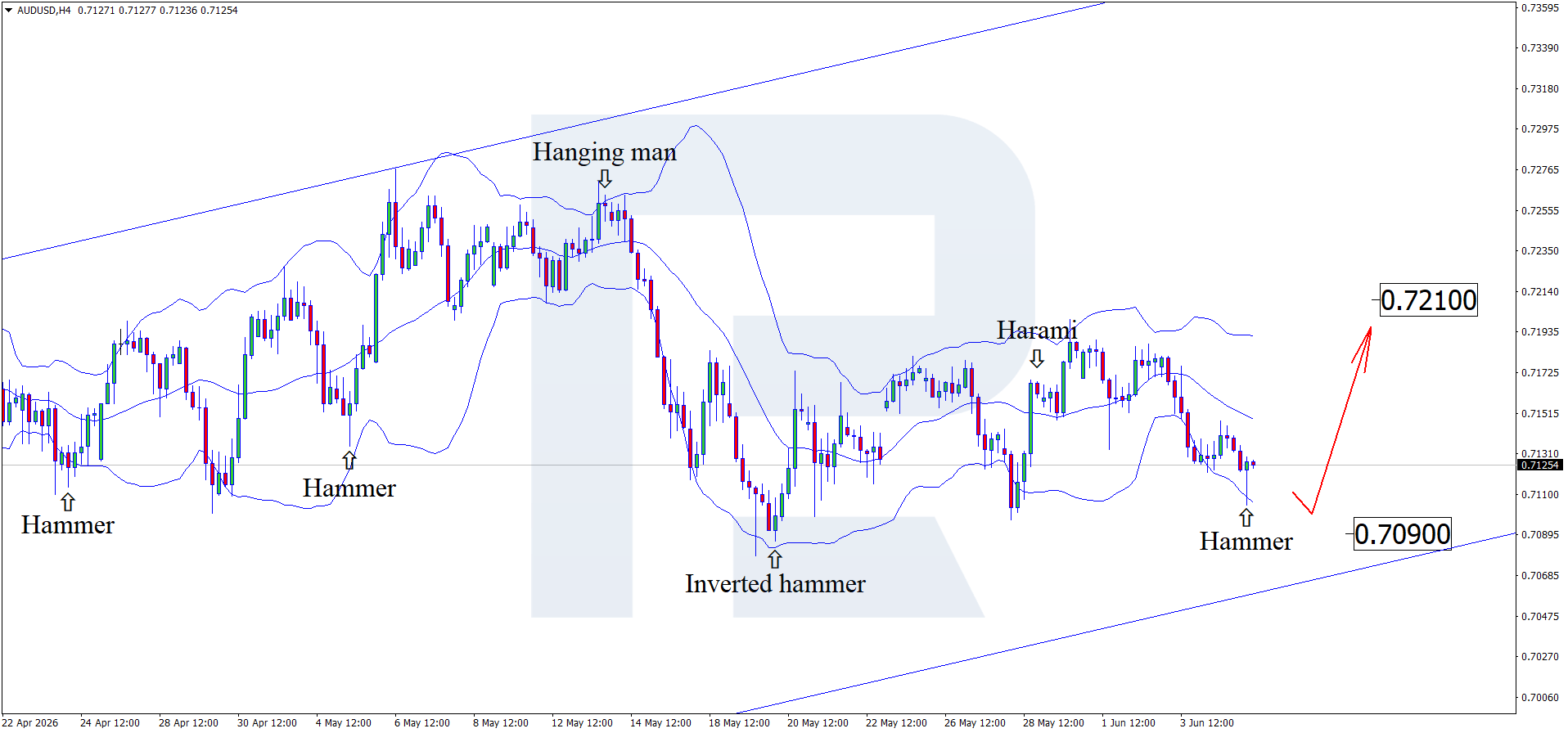
The market is underestimating the threat: AUDUSD may surprise today After a week of decline, the AUDUSD pair may spring a surprise amid the Nonfarm Payrolls release. Quotes are testing the 0.7120 level. Technical outlook The AUDUSD pair formed a Hammer reversal pattern near the lower Bollinger Band on the H4 chart. At this stage, quotes remain within an ascending channel and may continue their upward wave as the pattern signal plays out. The Australian dollar has not given up hope of strengthening; weak Australian statistics may be offset by weak US statistics. Read more - AUDUSD Forecast Attention! Forecasts presented in this section only reflect the author’s private opinion and should not be considered as guidance for trading. RoboForex bears no responsibility for trading results based on trading recommendations described in these analytical reviews. Sincerely, The RoboForex Team
-
Pips don’t pay your rent but the dollars do. Beginners count pips because $10 loss feels smaller than 10 pip loss. Check pip value first is checking if the bullet fits the gun. If you don’t know the dollar risk before entry, you’re gambling.
-
HFMarkets (hfm.com): Market analysis services.
AllForexnews replied to AllForexnews's topic in Fundamental Analysis
Date: 5th June 2026. Gold at a Crossroads: All Eyes on NFP Friday. As May’s NFP Change and the unemployment rate approaches for the US, Gold prices again take a dip. The price of the safe-haven asset has been forming a descending triangle pattern, indicating pressure on demand, but also forming a clear support level. The price movement of Gold and its outlook will particularly depend on the upcoming employment data. NFP Friday - What To Expect Market experts are expecting May’s NFP Employment Change to come in at 85,000, which is 30,000 lower than the previous month. Even though the market is expecting a lower employment change, a figure of 85,000 is still higher than the six-month average of 74,000. Traders can keep up to date with the latest releases with HFM's Calendar. The market also continues to expect the US unemployment rate to remain at 4.3% and for the average salary growth to be 0.3%. If the NFP reads higher than expectations, markets will expect the Dollar to potentially rise and Gold to simultaneously fall. Pressure on Gold will particularly rise if NFP comes in higher while the Unemployment Rate drops to 4.2%. However, traders should note that this would all depend on the data released. So far, this week’s employment data seems skewed toward an upside surprise or in line with current market expectations. The reason for this is that the recent ADP Employment figures beat expectations and rose to a 13-month high. In addition to this, the JOLTS Job Openings also came in considerably higher than expectations. However, yesterday’s Weekly Unemployment Claims rose to a four-month high of 225,000. The descending triangle pattern seen on Gold is also known to be a potential indication of downward price movement. Therefore, technical analysis will also be in line with the fundamentals if the US employment data is positive. However, a lower employment change and a higher unemployment rate can have the opposite effect. Gold Holds Neutral, But What Signals Are Emerging? On NFP Friday, the price of Gold fell during the Asian session by 1.09% to the $4,426.65 support level before rebounding at the London open. Nonetheless, the price continues to maintain lower highs and trades lower as the NFP release approaches. The US Dollar Index is also declining this morning, which can provide some support for Gold. However, a key factor will also be bond yields, which the US is struggling to keep below 4.50%. US bond yields in the last two weeks of May fell from their recent highs, but in June they have not fallen further. In June, bond yields have continued to trade sideways. How bond yields react after the NFP release will particularly impact Gold. If bond yields rise, gold may come under pressure, while lower bond yields can support the price. Gold trading remains active, although speculative positions continue to decline. This suggests that gold is moving away from its risk-driven investment appeal and returning to its traditional role as a safe-haven asset. According to the latest CFTC report, net speculative gold positions fell from 159.8 thousand to 154.3 thousand last week. However, investors still hold large buy positions. Buyers held 124.5 thousand positions, while sellers held 27.6 thousand. Last week, buyers slightly increased their positions, while sellers reduced theirs. Furthermore, what remains key for Gold is the possibility of an interest rate hike declining. Over the past 24 hours the possibility of a rate hike has remained at 46%, but investors will be watching how this changes after the NFP release. HFM - Gold 1-Hour Chart The price of Gold continues to remain below the key moving averages on the 1-hour and 2-hour charts. However, the price trades at 48.74 on the RSI, which is a clear neutral indication, meaning the price is not witnessing a clear sell signal. However, if the price declines below $4,442.15, Gold may see sell signals strengthen. If the price rises above $4,484.80, buy signals can potentially materialise. However, indications provided by technical analysis will also need to be in line with the NFP release, the US Dollar reaction, as well as the bond market. Key Takeaways: Gold remains under pressure ahead of the NFP release, with the price forming a descending triangle pattern. A stronger-than-expected NFP reading could support the US Dollar and pressure Gold, especially if unemployment falls and bond yields rise. A weaker NFP figure or higher unemployment rate could support Gold, particularly if the Dollar and US bond yields move lower after the release. Gold’s technical signal remains neutral for now. A move below $4,442.15 could strengthen sell signals, while a move above $4,484.80 could support buy signals. Always trade with strict risk management. Your capital is the single most important aspect of your trading business. Please note that times displayed based on local time zone and are from time of writing this report. Click HERE to access the full HFM Economic calendar. Want to learn to trade and analyse the markets? Join our webinars and get analysis and trading ideas combined with better understanding of how markets work. Click HERE to register for FREE! Click HERE to READ more Market news. Michalis Efthymiou HFMarkets Disclaimer: This material is provided as a general marketing communication for information purposes only and does not constitute an independent investment research. Nothing in this communication contains, or should be considered as containing, an investment advice or an investment recommendation or a solicitation for the purpose of buying or selling of any financial instrument. All information provided is gathered from reputable sources and any information containing an indication of past performance is not a guarantee or reliable indicator of future performance. Users acknowledge that any investment in Leveraged Products is characterized by a certain degree of uncertainty and that any investment of this nature involves a high level of risk for which the users are solely responsible and liable. We assume no liability for any loss arising from any investment made based on the information provided in this communication. This communication must not be reproduced or further distributed without our prior written permission. -
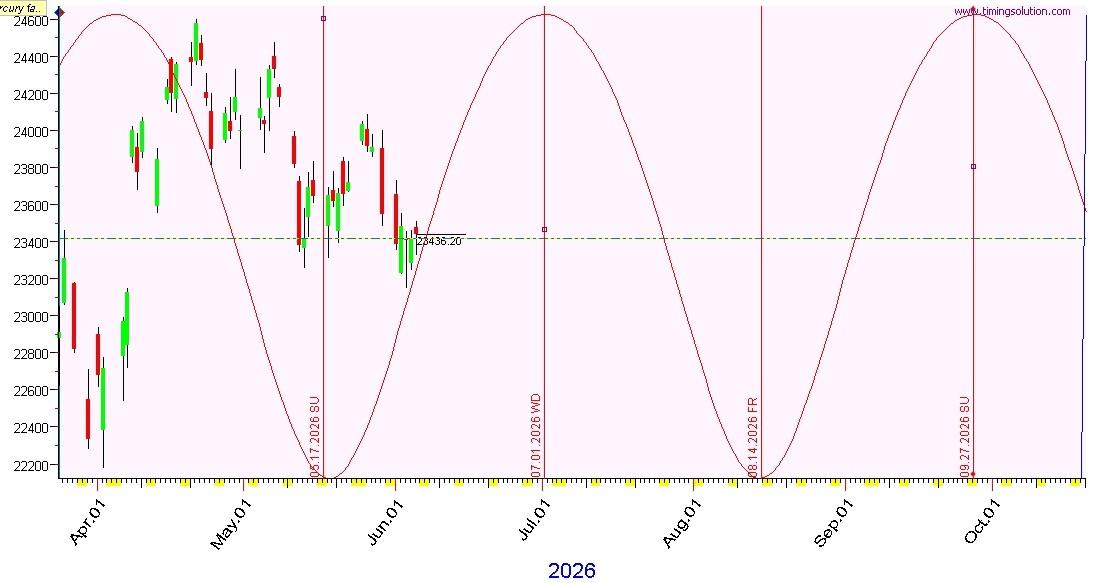
Yes Agreed, I am also trying to find tradeable technique on Nifty in TS. Astro based techniques tend deviate 1 or 2 days from the date of occurrence. Also I think we can not trade only based on Astro technique alone, we need to have validation from other technical indicators. Lets observe how Nifty reacts around future dates.
-
Santosh Thanks for the picture. What I have noticed in TS is that, historically its good at picking turning points/ups/downs. But on a forecasting basis, it mostly fails, this was my observation. Lost heavily based on its forecasts some years ago. Recall my posts earlier -:( Just as a validation, pickup 2 dates in the future and lets see if it works! Please understand, I am genuinely interested and not to test/poke fun !!