

⤴️-Paid Ad- Check advertising disclaimer here. Add your banner here.🔥
All Activity
- Past hour
-
 febtrade32 joined the community
 - Today
-
 satish joined the community
 -
 mohammad joined the community
 -
 DSZCC joined the community
 -
 qwer joined the community
 -
 qwfff joined the community
 - Yesterday
-
 m1ntz joined the community
 -
 XAUUSD Surges in One Day: Gold Shocks the Market Again! Gold delivered one of its strongest moves in recent months. During the August 5 trading session, XAUUSD gained about 4.4% and climbed above $4,250 per ounce — reaching its highest level in roughly seven weeks. The rally was especially notable after several months of decline. As recently as August 3, gold was trading near $4,030, meaning its value increased by more than 5% in just a few sessions! Earn up to $20 per lot in real funds — get guaranteed income by activating the Cashback promotion! Factors behind XAUUSD growth: Weaker dollar. The decline of the U.S. currency made gold cheaper for buyers from other countries and supported demand. At the same time, falling government bond yields reduced the advantage of interest-bearing assets over gold, which does not generate income on its own. Weak U.S. data. The private sector created fewer jobs than expected. After the data release, the probability of a Fed rate hike in September dropped from around 67% to 55%, providing an additional reason to buy gold. Falling oil prices. Talks between Iran and Oman increased hopes for restoring shipping through the Strait of Hormuz. Lower oil prices could ease inflationary pressure and reduce the need for further interest rate hikes. Return of buyers. Holding the key psychological level of $4,000 attracted traders expecting a rebound after a prolonged correction. Accelerating growth forced the closure of short positions, further strengthening the upward momentum. Despite the sharp jump, gold is still trading well below its January all-time high. Therefore, the current move could mark either the beginning of a new recovery phase or a short-term reaction to shifting expectations regarding Fed policy. According to FreshForex analysts, a move above $4,300 will confirm buyer strength and open the way for further growth, making current levels potentially attractive for buying gold. A drop back below $4,100 would weaken this scenario and indicate fading upward momentum. FreshForex offers 250+ trading instruments, including metals with leverage up to 1:1000. Exclusively for our readers — get $10 to start trading with no deposit required! Register, complete verification, and enter the promo code INDOINVEST10 in your Client Area. This is a limited offer: the bonus is available to the first 100 participants only.
 -

HFMarkets (hfm.com): Market analysis services.
AllForexnews replied to AllForexnews's topic in Fundamental Analysis
Date: 7th August 2026. Oil and Gold Rise as Traders Await the US Jobs Report. Key Takeaways Brent crude rose 1.4% to around $83.65 as uncertainty surrounding the Strait of Hormuz kept supply risks elevated. Gold advanced to approximately $4,264, supported by geopolitical uncertainty ahead of the US jobs report. The US 10-year Treasury yield held near 4.68% as higher oil prices revived inflation concerns. Economists expect the US economy to have added 80,000 jobs in July, following 57,000 additions in June. The US Dollar strengthened, while the Japanese Yen surrendered almost half of its recent intervention-driven gains. Asian stocks were mixed as Chinese equities rose, but AI-linked semiconductor shares remained under pressure. Oil prices Rise as Uncertainty over the Strait of Hormuz Continues Global markets entered Friday focused on two major risks: developments in the Strait of Hormuz and the release of the July US nonfarm payrolls report. Brent crude gained approximately 1.4% to $83.65 per barrel after hopes for a lasting agreement to reopen the strategic waterway weakened. Iranian reports suggested that Tehran may seek to restrict US and Israeli vessels, despite signs that an Iran-Oman arrangement could be approaching its final stages. Oil remained around 5% lower for the week after previously falling on optimism that the US and Iran would reach an agreement. This leaves prices highly sensitive to headlines. A credible deal could reduce the geopolitical premium, while further restrictions or attacks could quickly push supply concerns back into focus. The move matters beyond the energy market. Persistently high oil prices can raise transport and production costs, reinforce inflation, and make it harder for the Federal Reserve to lower interest rates. That prospect contributed to weakness in government bonds, with the US 10-year Treasury yield holding near 4.68%. Copper Rises on Supply Concerns and Strong Chinese Trade Copper prices moved higher after the Democratic Republic of Congo introduced an immediate ban on copper and cobalt concentrate exports. The decision raised concerns about global supply, briefly pushing London copper prices approximately 1.8% higher. Sentiment was also supported by strong Chinese trade data. China’s exports increased 23.9% year-on-year in July, while imports rose 27.5%, signalling resilient activity in the world’s largest copper-consuming economy. Traders should monitor whether supply restrictions and Chinese demand can keep copper near its recent record level. Gold Advances, but Higher Yields May Limit Gains Gold extended its recovery, with spot XAU/USD rising to around $4,264 an ounce. Silver also moved higher to approximately $62.26, while platinum reached around $1,740. Geopolitical uncertainty supported demand for precious metals, while Chinese gold-backed exchange-traded funds recorded a fourteenth consecutive session of inflows. However, gold faces competing forces. Middle East tensions can increase safe-haven demand, but higher oil prices may also lift inflation expectations, Treasury yields, and the US Dollar. Rising yields increase the opportunity cost of holding non-yielding gold and could restrict its upside. The late-June low near $3,942 remains an important technical reference. On the upside, the 200-day moving average near $4,489 represents a major test. A sustained break above it could strengthen the recovery, while a rejection from that area may signal that momentum is fading. US Nonfarm Payrolls could Reshape Fed Expectations The July US employment report is the day’s main scheduled event. Economists expect employers to have added 80,000 jobs, compared with a weaker-than-expected increase of 57,000 in June. Recent data have shown continued resilience. Initial jobless claims remained below 200,000 for a third consecutive week, while second-quarter productivity exceeded expectations. At the same time, higher energy prices have kept inflation, and the possibility of tighter Federal Reserve policy, at the centre of the market outlook. Traders should assess more than the headline payroll figure. Wage growth, unemployment, labour force participation, and revisions to previous months may determine whether the initial market reaction lasts. Three NFP Scenarios for Traders Stronger than expected: A result clearly above 80,000, particularly alongside firm wage growth or lower unemployment, could lift Treasury yields and the US Dollar. Gold, bonds, and rate-sensitive technology shares may face pressure. Weaker than expected: A soft figure could revive concerns about an economic slowdown and support Treasuries. Lower yields may weaken the Dollar and help gold, although equities could react negatively if the data point to a sharper deterioration in employment. Mixed report: A weak headline combined with strong wages, or a strong headline alongside higher unemployment, could produce volatile, short-lived moves. In this case, revisions and wage data may matter more than the initial number. US Dollar Strengthens as the Yen Loses Momentum The US Dollar strengthened against most major currencies as Treasury yields rose and geopolitical uncertainty supported defensive demand. The US Dollar Index traded close to 100 after recovering from seven-month lows. USD/JPY traded near 158.35 after falling as low as 155.23 earlier in the week. The Yen has now surrendered almost half of the gains generated by the first coordinated US-Japan intervention since 1998. The reversal shows that intervention can disrupt a currency trend without necessarily changing the interest rate forces behind it. The 155 area remains a key reference from the intervention move, while the late-July region near 164 may attract renewed attention to the risk of further official action. Asian Markets Remain Divided over the AI Trade Asian equities were mixed. China’s CSI 300 rose approximately 1% and the Shanghai Composite gained around 0.8% after the country reported a larger-than-expected July trade surplus. Exports increased 24% year over year, while imports rose 28%. Technology shares in South Korea and Japan remained under pressure as investors questioned whether elevated AI valuations could be justified by near-term earnings. South Korea’s KOSPI fell around 0.8%, with SK Hynix losing more than 4%. Japan’s Nikkei 225 declined approximately 0.3%, while Fujifilm plunged after announcing that it was considering a partial spin-off of its imaging business. Despite the recent AI-related sell-off, capital-raising activity remains strong. Asia-Pacific companies raised more than $83 billion through initial public offerings, placements, and block trades in July, indicating that corporate confidence remains high even as investors become more selective. What Traders Should Watch Today The US jobs report may generate the day’s largest scheduled move, but its effect will depend on oil prices and inflation expectations. The most important cross-market relationships are: Rising oil may lift inflation expectations, bond yields, and the US Dollar. Higher yields could limit gold’s safe-haven gains. A strong jobs report may pressure highly valued technology and AI shares. Renewed Yen weakness may increase the risk of further currency intervention. A credible Hormuz agreement could reverse part of oil’s geopolitical premium. With major economic data and geopolitical headlines arriving together, volatility may remain elevated across commodities, currencies, bonds, and stock indices. Traders should review the full employment report, prepare for wider spreads, and apply disciplined risk management around the release. Always trade with strict risk management. Your capital is the single most important aspect of your trading business. Please note that times displayed based on local time zone and are from time of writing this report. Click HERE to access the full HFM Economic calendar. Want to learn to trade and analyse the markets? Join our webinars and get analysis and trading ideas combined with better understanding of how markets work. Click HERE to register for FREE! Click HERE to READ more Market news. Andria Pichidi HFMarkets Disclaimer: This material is provided as a general marketing communication for information purposes only and does not constitute an independent investment research. Nothing in this communication contains, or should be considered as containing, an investment advice or an investment recommendation or a solicitation for the purpose of buying or selling of any financial instrument. All information provided is gathered from reputable sources and any information containing an indication of past performance is not a guarantee or reliable indicator of future performance. Users acknowledge that any investment in Leveraged Products is characterized by a certain degree of uncertainty and that any investment of this nature involves a high level of risk for which the users are solely responsible and liable. We assume no liability for any loss arising from any investment made based on the information provided in this communication. This communication must not be reproduced or further distributed without our prior written permission. -

Market Technical Analysis by RoboForex
RBFX Support replied to RBFX Support's topic in Technical Analysis
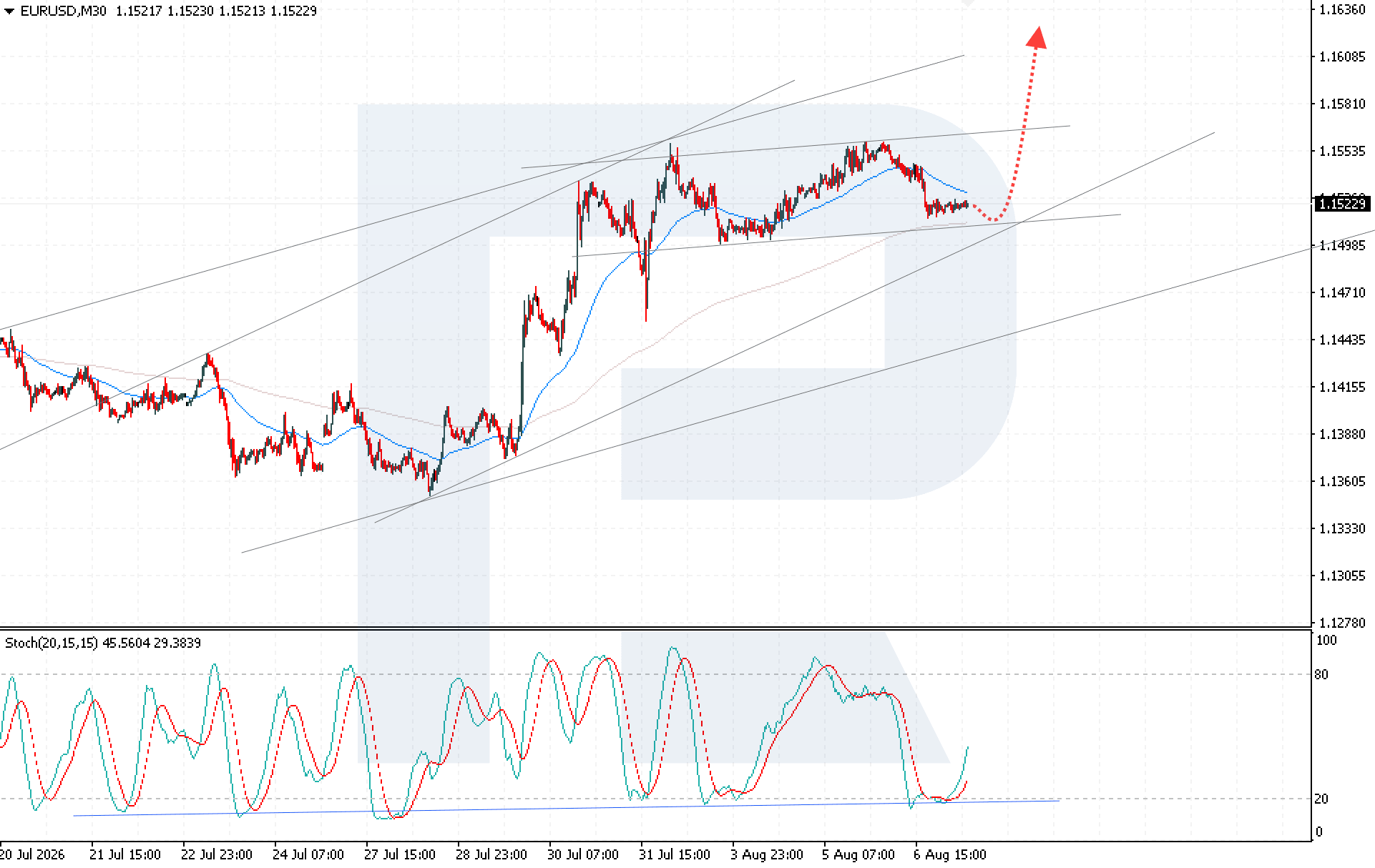
EURUSD holds steady ahead of Nonfarm Payrolls The EURUSD pair is stabilising after its decline, remaining within a narrow range ahead of key US labour market data. The rate currently stands at 1.1522. Technical outlook The EURUSD rate is declining and has almost reached the lower boundary of the bullish channel. Today’s EURUSD forecast suggests a renewed upward movement, with a potential target at 1.1635. The EURUSD pair remains in a consolidation phase ahead of the Nonfarm Payrolls release. Read more - EURUSD Forecast Attention! Forecasts presented in this section only reflect the author’s private opinion and should not be considered as guidance for trading. RoboForex bears no responsibility for trading results based on trading recommendations described in these analytical reviews. Sincerely, The RoboForex Team
-
roboforex Market Fundamental Analysis by RoboForex
RBFX Support replied to RBFX Support's topic in Fundamental Analysis
NFP could send Dogecoin into a new trend The House of Doge team continues to expand cooperation with payment and fintech companies, while the Dogecoin price may form a correction against this backdrop. The current quote is 0.06920 DOGEUSD forecast: key takeaways US initial jobless claims: previously at 198 thousand, currently at 199 thousand The House of Doge team continues to expand cooperation with payment and fintech companies The number of services accepting DOGE could increase significantly in the near term Fundamental analysis Today’s DOGEUSD fundamental analysis takes into account that Dogecoin is consolidating near 0.0692, remaining within a sideways trend that has continued since early July. A key driver of long-term growth remains the development of the DOGE Pay payment network, launched with the involvement of House of Doge and MoonPay. RoboForex Market Analysis & Forex Forecasts Attention! Forecasts presented in this section only reflect the author’s private opinion and should not be considered as guidance for trading. RoboForex bears no responsibility for trading results based on trading recommendations described in these analytical reviews. Sincerely, The RoboForex Team -
Welcome to Indo-Investasi.com. Please feel free to browse around and get to know the others. If you have any questions please don't hesitate to ask.
-
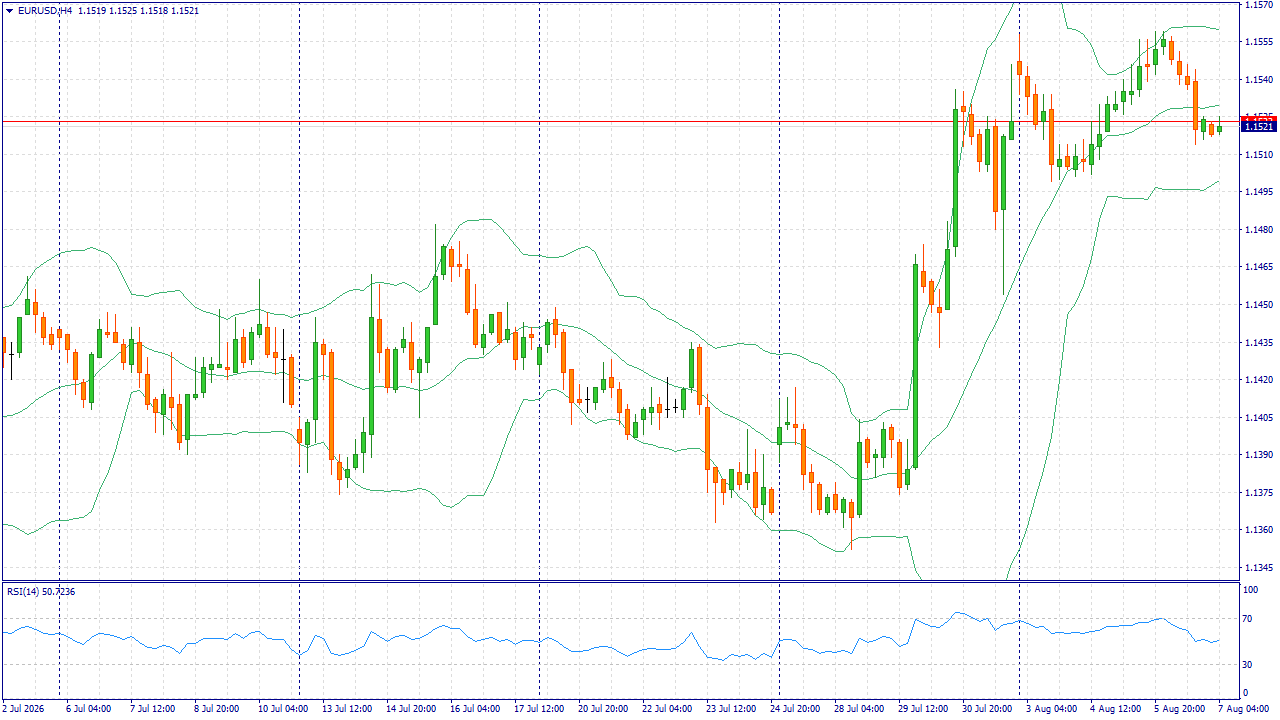
Market Fundamental Analysis for August 7, 2026 EURUSD Event to watch today: 15:30 EET. USD - Non-Farm Employment Change EURUSD: Exclusively for our readers — get $10 to start trading with no deposit required! Register, complete verification, and enter the promo code INDOINVEST10 in your Client Area. This is a limited offer: the bonus is available to the first 100 participants only. The euro begins the session against a mixed domestic backdrop. Eurozone inflation accelerated to 2.9%, while the core rate rose to 2.5%, maintaining expectations of further ECB policy tightening. Second-quarter economic growth was more resilient than forecast. However, the unexpected decline in Italian industrial production shows that the recovery remains uneven and is not providing the euro with an independent source of strength against the dollar. The main driver of the day is the US labor market report. The market expects employment growth to accelerate following the weak June result, while unemployment is forecast to remain at 4.2%. The Federal Reserve kept its policy rate within the 3.50–3.75% range in July and continues to emphasize that future decisions will depend on incoming data. Ahead of the release, this supports cautious demand for the dollar amid persistent inflationary pressure. The euro is receiving support from expectations surrounding the ECB, but this factor has already been largely priced in and is constrained by the uneven economic picture across the region. Unless US employment data comes in significantly below expectations, the dollar may retain the advantage. The baseline scenario allows for a moderate decline in EURUSD, while a weak US report remains the main risk to the selling idea. Trading idea: SELL 1.1525, SL 1.1555, TP 1.1455
- Last week
-
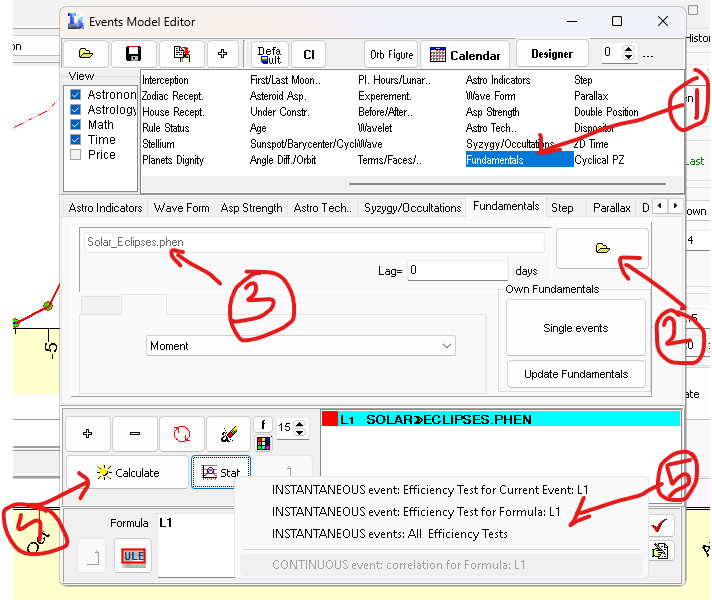
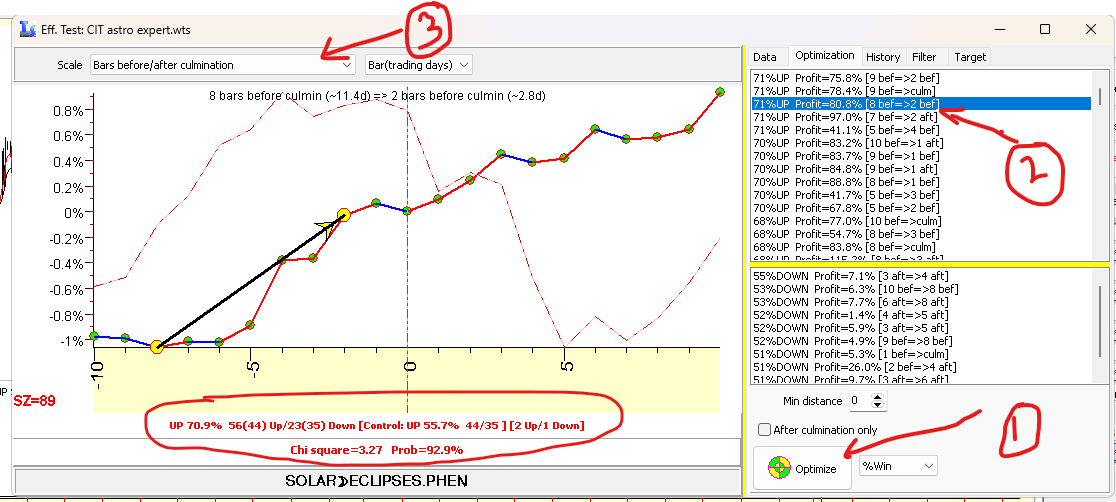
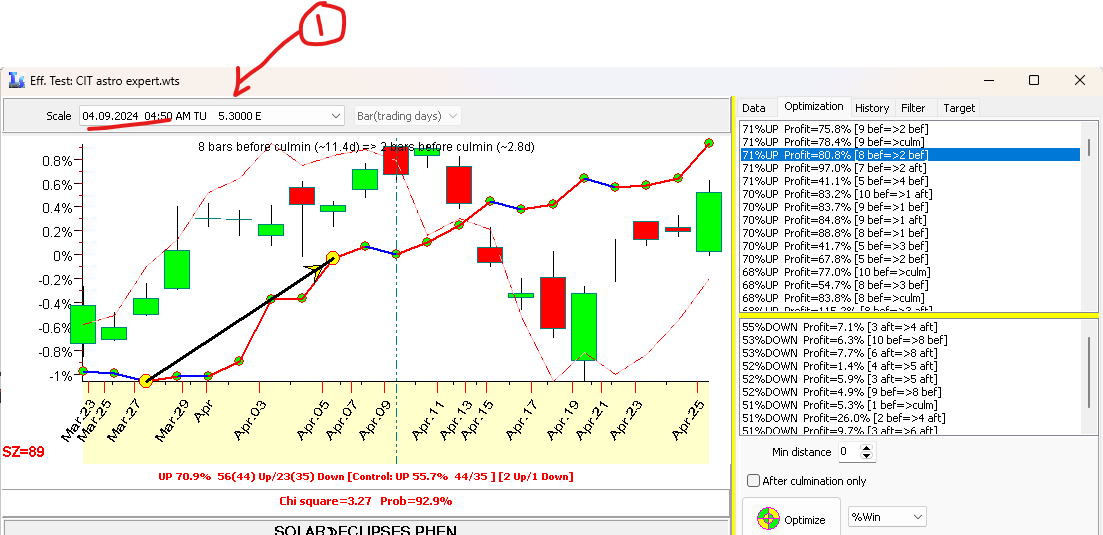
Solar eclipse is around i was checking the effect on nifty found high probability event showing up movement from 3rd Aug to 11 Aug, below are the screen shots how to do it. Run Fundamentals from ULE model & in efficiency test optimize it to get predictable zones.
-
Welcome to Indo-Investasi.com. Please feel free to browse around and get to know the others. If you have any questions please don't hesitate to ask.
-
roboforex Market Fundamental Analysis by RoboForex
RBFX Support replied to RBFX Support's topic in Fundamental Analysis
Solana may become scarce as developers prepare a major update After its decline, the Solana price is developing a new upward wave in anticipation of updates, currently trading at 73.60. SOLUSD forecast: key takeaways The validator community is still debating the SGP-0003 package Developers continue to prepare the Alpenglow update for release SOLUSD forecast for 6 August 2026: 76.75 or 72.90 Fundamental analysis The validator community is still debating the SGP-0003 package, which includes the SIMD-0550 and SIMD-0553 proposals. If adopted, the network could significantly increase the daily burn of SOL through a new fee while also slowing the issuance of new coins more rapidly. In the longer term, this may become a factor putting pressure on the amount of tokens in circulation. The SOLUSD forecast for 6 August 2026 takes into account that institutional investor interest in the ecosystem remains strong. Following the recent launch of tokenised money market funds and the more active use of the network for stablecoin settlements, Solana is becoming increasingly established as infrastructure for traditional finance, rather than only for DeFi and NFTs. RoboForex Market Analysis & Forex Forecasts Attention! Forecasts presented in this section only reflect the author’s private opinion and should not be considered as guidance for trading. RoboForex bears no responsibility for trading results based on trading recommendations described in these analytical reviews. Sincerely, The RoboForex Team -
Market Technical Analysis by RoboForex
RBFX Support replied to RBFX Support's topic in Technical Analysis
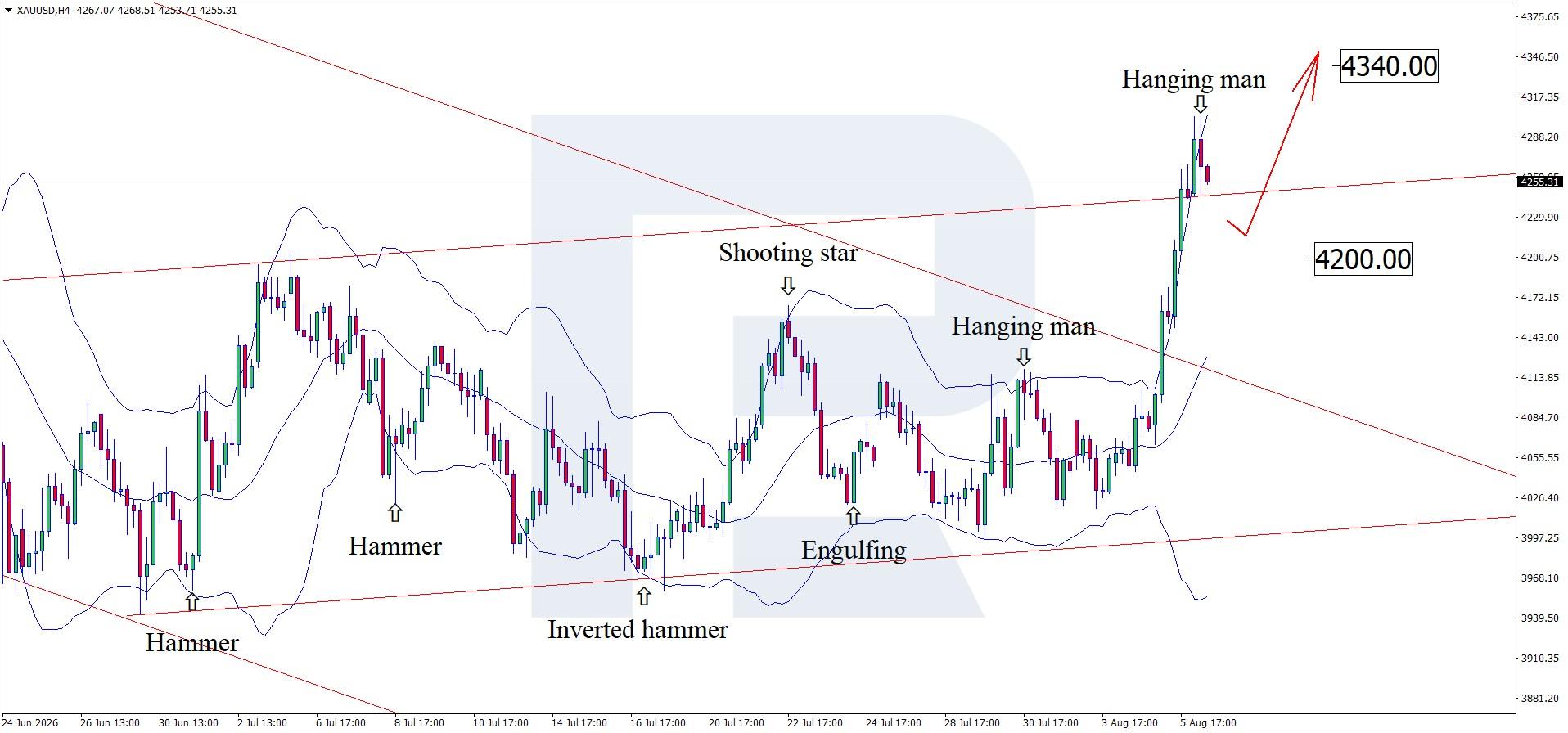
Gold catches a wave: can XAUUSD maintain momentum after NFP? Gold is forming a corrective wave after its surge. The main trigger of the week is the Nonfarm Payrolls report. Prices currently stand at 4,255 USD Technical outlook On the H4 chart, XAUUSD prices formed a Hanging Man reversal pattern near the upper Bollinger Band. As the pattern signal develops, quotes may continue their corrective wave. Gold continues to strengthen amid a weaker USD and expectations ahead of the US employment data release. Read more - Gold Forecast Attention! Forecasts presented in this section only reflect the author’s private opinion and should not be considered as guidance for trading. RoboForex bears no responsibility for trading results based on trading recommendations described in these analytical reviews. Sincerely, The RoboForex Team
-
 The link isn't working. Can I set a new link? Thank you.
 -
HFMarkets (hfm.com): Market analysis services.
AllForexnews replied to AllForexnews's topic in Fundamental Analysis
Date: 6th August 2026. Gold Posts Its Biggest Rise in Six Months: Can the Rally Continue? Gold sees its largest bullish rise in six months as oil prices continue to fall. Crude oil prices have now fallen to $75.00, the lowest in almost four weeks due to a possible Oman-Iran agreement. According to Iran, an agreement has been reached but does not necessarily open the strait fully. Gold is rising as investors expect lower oil prices to pressure inflation, meaning fewer interest rate hikes. As a result, investors can again invest in non-yielding assets such as Gold. However, this primarily depends on how low oil prices and inflation fall. 38% of analysts continue to expect the Federal Reserve to hike twice this year, while 43% believe it will hike once. As a result, the price of oil and next week’s inflation rate will primarily determine if Gold’s momentum will continue. Crude Oil - Iran and Oman Reach a Temporary Agreement on The Strait of Hormuz Oman and Iran have come to an agreement to safely open the strait to certain ships. However, Iran has also said the deal will proceed if ‘certain parties do not obstruct the process’. Here, Iran is referring to the US, which is holding separate talks with Iran. Oil prices are falling based on the news of the agreement. However, investors should note that the agreement is relatively weak. The agreement only covers a limited number of ships through a small route. In addition to this, the US continues to block the strait to Iran. For this reason, market analysts remain cautious about any positive news while the US does not have an agreement in place with Iran. In the past two weeks the price has fallen by 21% but based on historic correlations between oil prices and inflation, this is not enough to pressure inflation. The Federal Reserve is looking to push inflation to 2%, with inflation currently at 3.5%. As a general rule, most economists believe that if oil prices remain 10% lower than their previous price, inflation falls by a maximum of 0.40%. So far, inflation has fallen by 20% meaning a further 10% is needed to bring inflation down to its target. Therefore, oil would need to fall to $66 per barrel and remain there for some time in order for inflation to fall to 2%. Otherwise, the Federal Reserve is likely to continue considering interest rate adjustments. Currently, the price of Crude Oil is struggling to cross below the support level of $74.40. Over the past 24 hours three attempts have been seen. However, the price action will largely depend on the US and Iranian negotiations. If the price breaks below the support level, technical analysts will maintain a bearish bias, targeting the psychological $70.00 level next, followed by support at $68.00. HFM - Crude Oil 30-Minute Chart Gold - Importance of Inflation Gold prices saw a significant surge on Wednesday in response to lower oil prices, a weaker Dollar and hopes that this could lower inflation. However, this cannot yet be known, as demand and the employment sector remains resilient. On Wednesday, three members of the Federal Reserve spoke to journalists about monetary policy. All three generally sounded hawkish and willing to hike interest rates. Tomorrow’s NFP data will trigger volatility for Gold and the US Dollar, however, the inflation rate next week will be more influential. Stronger NFP data and higher inflation are likely to weaken Gold, while weaker data could fuel a medium-term rise. Gold’s technical outlook remains cautiously bullish in the short term. The price is trading above its 50-day moving average, and momentum indicators continue to strengthen. Immediate resistance is located around $4,300, and a break above this price could indicate a further rise. On the downside, traders may first target the $4,220–$4,200 support zone, followed by the more significant $4,157 level. As long as gold remains above $4,160, bearish signals are avoided; however, a rejection from $4,300 and a break below this support would weaken the bullish structure. HFM - Gold 30-Minute Chart Key Takeaway Points: Gold posted its strongest six-month rally as oil prices and the US Dollar declined. The temporary Oman-Iran agreement pushed crude oil towards $75, but the deal remains limited and uncertain. Oil may need to fall towards $66 and stay there to significantly reduce inflation pressure to the Fed’s target. Gold’s next major catalysts are the US jobs report and next week’s inflation data. Gold remains cautiously bullish above $4,160, with resistance near $4,300. Always trade with strict risk management. Your capital is the single most important aspect of your trading business. Please note that times displayed based on local time zone and are from time of writing this report. Click HERE to access the full HFM Economic calendar. Want to learn to trade and analyse the markets? Join our webinars and get analysis and trading ideas combined with better understanding of how markets work. Click HERE to register for FREE! Click HERE to READ more Market news. Michalis Efthymiou HFMarkets Disclaimer: This material is provided as a general marketing communication for information purposes only and does not constitute an independent investment research. Nothing in this communication contains, or should be considered as containing, an investment advice or an investment recommendation or a solicitation for the purpose of buying or selling of any financial instrument. All information provided is gathered from reputable sources and any information containing an indication of past performance is not a guarantee or reliable indicator of future performance. Users acknowledge that any investment in Leveraged Products is characterized by a certain degree of uncertainty and that any investment of this nature involves a high level of risk for which the users are solely responsible and liable. We assume no liability for any loss arising from any investment made based on the information provided in this communication. This communication must not be reproduced or further distributed without our prior written permission. -
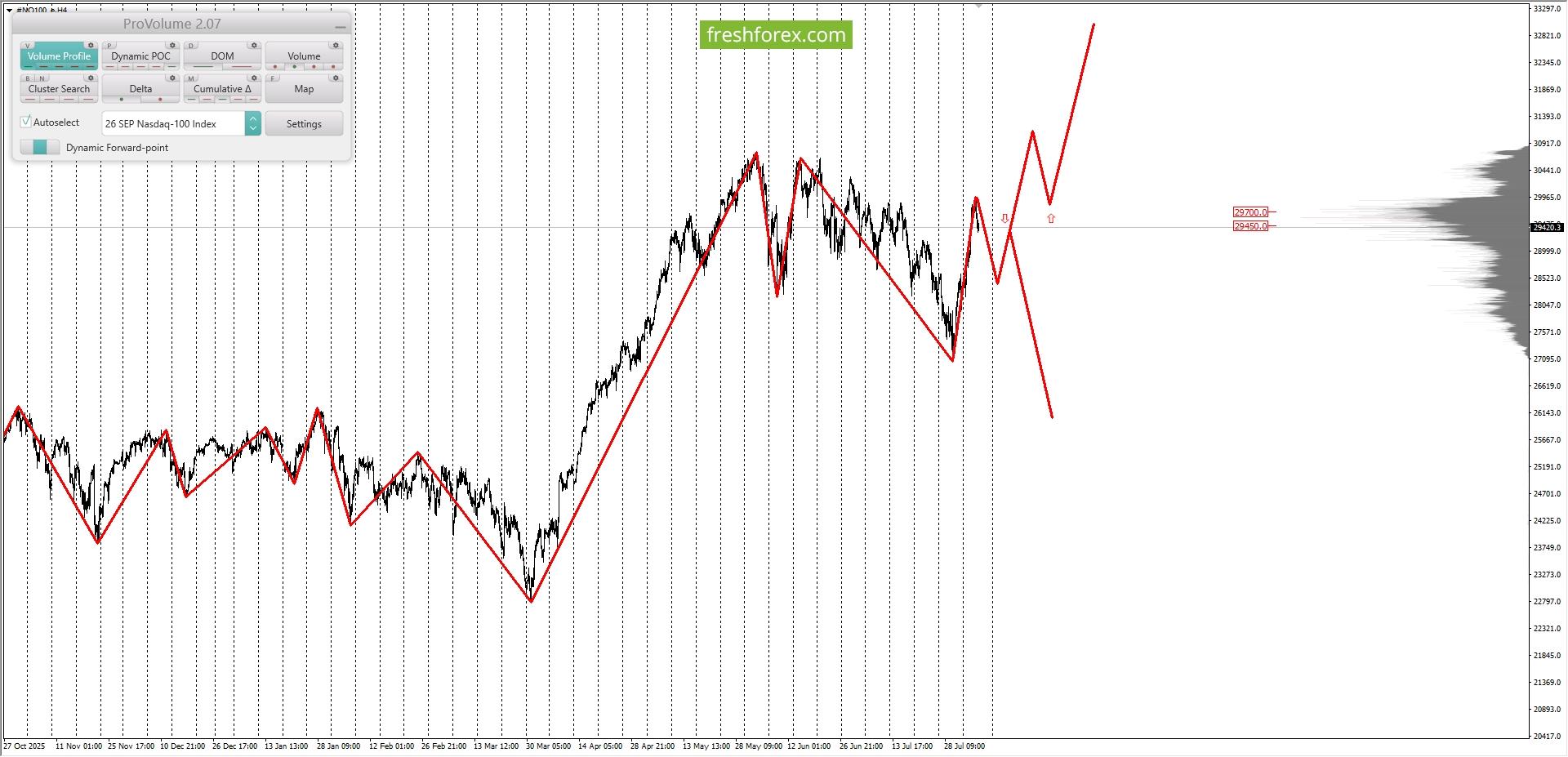
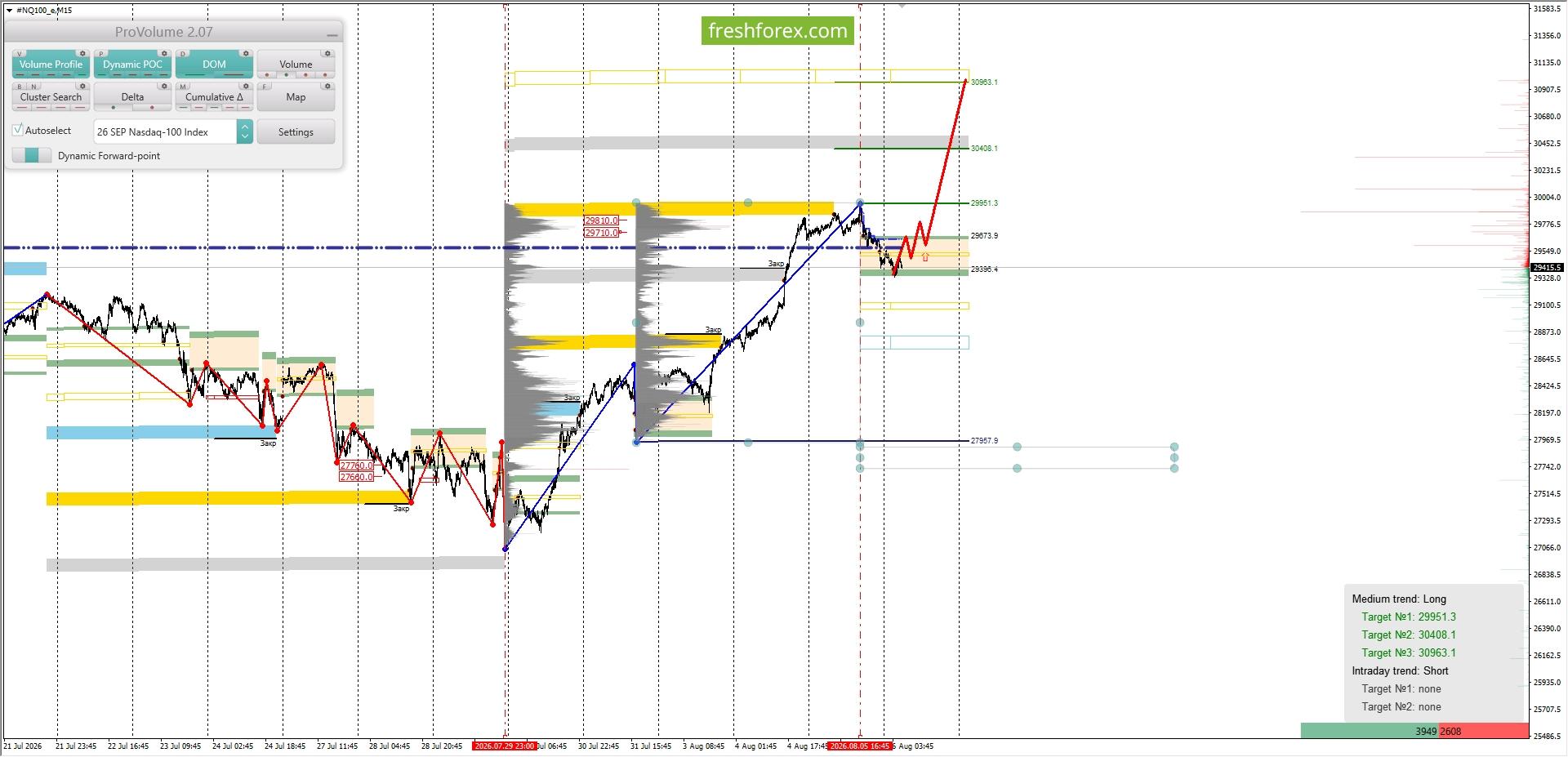
Analysis of margin levels for August 6, 2026 #NQ100 #NQ100: BUY 29364.4-29673.9, TP1-29951.3, TP2-30963.1. Exclusively for our readers — get $10 to start trading with no deposit required! Register, complete verification, and enter the promo code INDOINVEST10 in your Client Area. This is a limited offer: the bonus is available to the first 100 participants only. Long-term trend: bearish. The highest concentration of volumes in the current contract is located within the 29450.0–29700.0 range. Investment activity in #NQ100 is currently taking place below this range, indicating seller strength. Medium-term trend: bullish. The highest concentration of medium-term volumes is located within the 27660.0–27760.0 and 29710.0–29810.0 ranges. Investment activity in #NQ100 is currently taking place within this range, indicating temporary uncertainty. From the perspective of margin requirements, the favorable buying area is located between the 1/4 and 1/2 zones constructed from the high of 05.08.2026. The upper boundary of the 1/4 zone is 29673.9. The upper boundary of the 1/2 zone is 29364.4. Intraday target: a retest of the 05.08.2026 high at 29951.3. Medium-term target: a test of the lower boundary of the GWCZ at 30963.1. Investment recommendation: buy from the favorable price range if a reversal pattern forms. Buy: 29364.4-29673.9, Take Profit 1-29951.3, Take Profit 2-30963.1.
-
This topic is for an e-book. Perhaps you may have better success posting this as a separate topic.
-
Bro to bother u,
Which ema do you use for your meanrenko on mt4 please.
I see u use 2 ema.
U can tell me their size
-
roboforex Market Fundamental Analysis by RoboForex
RBFX Support replied to RBFX Support's topic in Fundamental Analysis
US 30 forecast: the index reaches a new all-time high The US 30 index rose by more than 5% and hit a new all-time high. The US 30 forecast for today is positive. US 30 forecast: key takeaways Recent data: the US Federal Reserve kept its interest rate unchanged at 3.75% Market impact: the data is moderately positive for the stock market Fundamental analysis The Federal Reserve’s decision to keep the target range for the federal funds rate at 3.50–3.75% was formally in line with market expectations. However, the statement and the comments from the Fed leadership are more important than the fact that the rate was left unchanged. For the US 30 index, the news is primarily a restraining factor. Keeping the rate unchanged could have supported the market, as companies and investors did not face an immediate further increase in financing costs. RoboForex Market Analysis & Forex Forecasts Attention! Forecasts presented in this section only reflect the author’s private opinion and should not be considered as guidance for trading. RoboForex bears no responsibility for trading results based on trading recommendations described in these analytical reviews. Sincerely, The RoboForex Team -
Gold is too volatile for me for intraday trading, but it does tend to follow seasonal patterns well. I entered a long position on June 29 with a tight stop. The entry was confirmed by a bullish engulfing pattern—a signal that has historically always led to a rise in the price of gold. The 76.4% retracement level at approximately $4,655 should be reached at a minimum; the price might even hit $5,000. However, the price should not drop below $4,000.