

⤴️-Paid Ad- Check advertising disclaimer here. Add your banner here.🔥
All Activity
- Past hour
-
 abcd joined the community
 -
 rblib joined the community
 -
Welcome to Indo-Investasi.com. Please feel free to browse around and get to know the others. If you have any questions please don't hesitate to ask.
- Today
-
 rerote1210 joined the community
 -
Welcome to Indo-Investasi.com. Please feel free to browse around and get to know the others. If you have any questions please don't hesitate to ask.
-
 kd0777774 joined the community
 -

Market Technical Analysis by RoboForex
RBFX Support replied to RBFX Support's topic in Technical Analysis
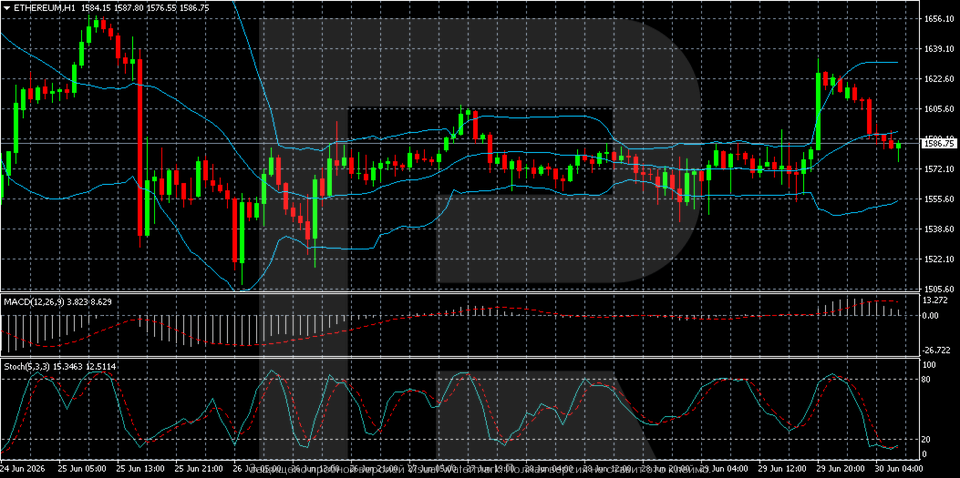
Ethereum (ETHUSD) will resume growth after a pause for profit-taking The Ethereum (ETHUSD) price paused near 1,585 USD, with the market caught up in profit-taking. Technical outlook On the Ethereum (ETHUSD) H1 chart, following a sharp upward momentum to the 1,625 area, the price entered a correction phase and pulled back to the 1,585–1,590 range. Quotes are now consolidating near the middle Bollinger Band, indicating a temporary balance between buyers and sellers after the spike in volatility. The Ethereum price declined, driven by quarterly profit-taking, and then paused. Read more - ETHUSD Forecast Attention! Forecasts presented in this section only reflect the author’s private opinion and should not be considered as guidance for trading. RoboForex bears no responsibility for trading results based on trading recommendations described in these analytical reviews. Sincerely, The RoboForex Team
-
roboforex Market Fundamental Analysis by RoboForex
RBFX Support replied to RBFX Support's topic in Fundamental Analysis
Brent decline or a fresh surge? The market awaits the US-Iran verdict The oil market has frozen in anticipation of the outcome of US-Iran negotiations, with prices hovering around 73.30. Brent forecast: key takeaways Brent is forming a correction after the decline The talks in Doha are the main event of the day Tanker companies are gradually resuming passage through the strait Fundamental analysis The Brent forecast for 30 June 2026 shows that prices are forming a corrective wave after the decline. The market is frozen in tense anticipation of the upcoming US-Iran talks. On the one hand, investors are hoping for diplomatic progress, while on the other, actual supplies through the Strait of Hormuz are still far from returning to normal. The talks in Doha are in the spotlight today. Investors are pricing in a positive outcome of the meeting, even though the strait has not yet been reopened. Despite the remaining risks, tanker companies are gradually resuming passage through the strait. RoboForex Market Analysis & Forex Forecasts Attention! Forecasts presented in this section only reflect the author’s private opinion and should not be considered as guidance for trading. RoboForex bears no responsibility for trading results based on trading recommendations described in these analytical reviews. Sincerely, The RoboForex Team -

HFMarkets (hfm.com): Market analysis services.
AllForexnews replied to AllForexnews's topic in Fundamental Analysis
Date: 30th June 2026. Yen Hits 1986 Low as Nikkei 225 Reacts to Currency Pressure. The Japanese Yen has fallen to its lowest level against the US Dollar since 1986 and is now the worst-performing currency of 2026. The decline is due to the lack of indications from the Bank of Japan reassuring investors of higher interest rates. In addition to this, the US Dollar is increasing against all currencies as investors price in 2 rate adjustments for 2026. Japanese Yen Weakness The Japanese Yen has been struggling in 2026. This particularly includes during the US-Iran conflict and since the new Federal Reserve Chairman took office. At times, the increase was largely driven by the safe haven status of the Dollar and inflation. However, the Dollar is now witnessing strong gains due to rate hike expectations. In addition to this, the European Central Bank has already adjusted interest rates, and the Bank of England is likely to follow. For this reason, the Japanese Yen is becoming less and less attractive to investors. The interest rates in Japan cannot compete with other major economies and economists fear the Japanese government may struggle to pay its debt at such high bond yields. Furthermore, the Japanese 10-year government bond yield is currently trading at 2.675, more than double that seen in early 2025. Japan is also increasing its national debt, and its debt-to-GDP levels are higher than most major economies. This is again decreasing confidence in the government. Furthermore, the conflict involving the US, Israel and Iran has also increased pressure on the yen. Japan relies heavily on imported energy, with more than 95% of its oil imports coming from the Middle East, leaving it highly vulnerable to regional disruptions. The weaker yen is supporting exporter profits and helping push Japan’s stock market to record highs, but it is also driving up import costs, especially for Dollar-priced oil and gas, which could put pressure on Prime Minister Sanae Takaichi’s government. In response, Japanese authorities may step up verbal warnings or proceed with direct intervention, having already spent a record ¥11.73 trillion between April 28 and May 27 to support the currency. NIKKEI 225 - Lower Yen Supports Demand For Japanese Stocks The NIKKEI 225 is witnessing both up and down impulse waves as market participants are evaluating the effect of currency fluctuations on the economy. The weaker Japanese Yen is positive for the NIKKEI 225. However, investors are concerned about the domino effect the weak currency can have on the economy. The weaker JPY can result in higher inflation, which can prompt more interest rate hikes. If the Bank of Japan indicates multiple rate hikes, the NIKKEI 225 can come under renewed pressure. HFM - USDJPY 1-Hour Chart The price of the index moved higher but failed to hold near the 70,700–70,730 area. On the 5-minute chart, that usually suggests buyers are still active, but short-term profit-taking has appeared near the highs. This also suggests investors are cautious about the Yen and holding onto longer-term positions. On the 1-hour chart, the price of the index is currently seeing a neutral indication from the RSI and the Moving Averages. However, the price is clearly witnessing a support level at 68,500. While the price remains above this level, the index maintains possible bullish scenarios. Nonetheless, the descending triangle pattern provides a slight bearish bias. If the price is to decline in the short-term, the first target traders potentially may focus on is slightly above the support level. USDJPY - The US Dollar Maintains Bullish Momentum The USDJPY is witnessing clear bullish indications from all momentum-based indicators on most timeframes. However, investors continue to expect the Japanese government will intervene to support the currency. The higher the USDJPY goes, the stronger the possibilities of the government taking harsher measures. For this reason, smaller timeframes are particularly important for technical analysis. This includes the 5-Minute and 15-Minute charts. Currently, the price maintains a bullish bias despite the price retracing down to 162.200. However, if the price falls below 162.30, bullish indications for the short-term will fade. HFM - USDJPY 15-Minute Chart For the US Dollar, the JOLTS Job Openings and CB Consumer Confidence releases in the afternoon will impact order flow. If the two releases read better than expectations, particularly the job openings, the US Dollar can continue to rise further. Job openings in the US have read higher than expectations over the past 4-months. Key Takeaways: The yen hit its weakest level since 1986 as low Japanese rates and US rate expectations weigh. A weaker Yen supports exporters and the Nikkei 225, but higher import costs are fuelling inflation concerns. Japan may increase intervention if Yen weakness continues, after spending a record ¥11.73 trillion earlier this year. USDJPY remains bullish, but intervention risk and key US data could quickly shift short-term momentum. Always trade with strict risk management. Your capital is the single most important aspect of your trading business. Please note that times displayed based on local time zone and are from time of writing this report. Click HERE to access the full HFM Economic calendar. Want to learn to trade and analyse the markets? Join our webinars and get analysis and trading ideas combined with better understanding of how markets work. Click HERE to register for FREE! Click HERE to READ more Market news. Michalis Efthymiou HFMarkets Disclaimer: This material is provided as a general marketing communication for information purposes only and does not constitute an independent investment research. Nothing in this communication contains, or should be considered as containing, an investment advice or an investment recommendation or a solicitation for the purpose of buying or selling of any financial instrument. All information provided is gathered from reputable sources and any information containing an indication of past performance is not a guarantee or reliable indicator of future performance. Users acknowledge that any investment in Leveraged Products is characterized by a certain degree of uncertainty and that any investment of this nature involves a high level of risk for which the users are solely responsible and liable. We assume no liability for any loss arising from any investment made based on the information provided in this communication. This communication must not be reproduced or further distributed without our prior written permission. -
Welcome to Indo-Investasi.com. Please feel free to browse around and get to know the others. If you have any questions please don't hesitate to ask.
-
 badboy202069 joined the community
 -
Welcome to Indo-Investasi.com. Please feel free to browse around and get to know the others. If you have any questions please don't hesitate to ask.
-
Anyone want to join us for shopping?
-
 TheJoker7745 joined the community
 -
Welcome to Indo-Investasi.com. Please feel free to browse around and get to know the others. If you have any questions please don't hesitate to ask.
- Yesterday
-
 seekerhs2012 joined the community
 -
 Billy Bob joined the community
 -
 markaus joined the community
 -
 Flavio. joined the community
 -
roboforex Market Fundamental Analysis by RoboForex
RBFX Support replied to RBFX Support's topic in Fundamental Analysis
DE 40 forecast: the index lacks a directional trend The DE 40 stock index entered a medium-term sideways channel. The DE 40 forecast for today is negative. DE 40 forecast: key takeaways Recent data: Germany’s preliminary services PMI came in at 46.8 in June Market impact: the data creates a positive backdrop for the German stock market Fundamental analysis Germany’s services PMI data looks negative for the DE 40 index, with the actual reading coming in at 46.8 points, below the forecast of 49.0 and the previous 48.1. Since a reading below 50.0 points indicates a contraction in business activity, the market may interpret this publication as a signal of deterioration in the German economy, particularly in domestic demand and the services sector. For the DE 40 index, this news creates pressure, all else being equal. Investors may revise expectations for revenue and earnings at German companies, especially those whose businesses depend on consumer spending, corporate services, lending, and domestic economic activity. RoboForex Market Analysis & Forex Forecasts Attention! Forecasts presented in this section only reflect the author’s private opinion and should not be considered as guidance for trading. RoboForex bears no responsibility for trading results based on trading recommendations described in these analytical reviews. Sincerely, The RoboForex Team -
Market Technical Analysis by RoboForex
RBFX Support replied to RBFX Support's topic in Technical Analysis
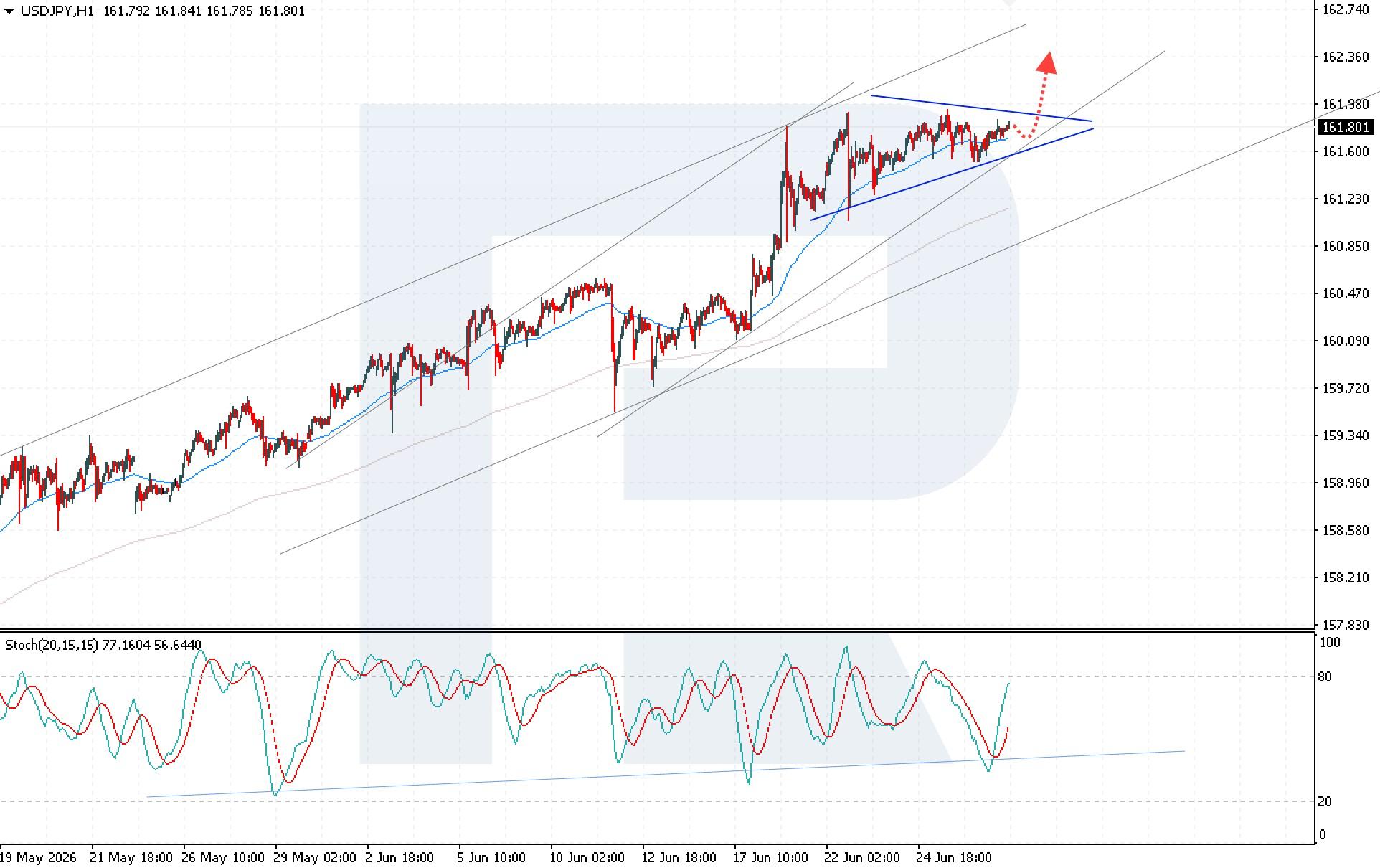
USDJPY is consolidating within a Triangle pattern The USDJPY pair resumed growth following a correction, but buyers continue to face strong resistance. The rate currently stands at 161.80. Technical outlook The USDJPY rate is correcting within a developing Triangle pattern. At the same time, buyers continue to hold the price above the EMA-65, indicating continued bullish pressure. Today’s USDJPY forecast suggests a renewed upward move, with a target at 162.35. Despite expectations of further BoJ policy tightening, the USDJPY pair retains an upward bias due to the continuing interest rate gap between the US and Japan. Read more - USDJPY Forecast Attention! Forecasts presented in this section only reflect the author’s private opinion and should not be considered as guidance for trading. RoboForex bears no responsibility for trading results based on trading recommendations described in these analytical reviews. Sincerely, The RoboForex Team
-
HFMarkets (hfm.com): Market analysis services.
AllForexnews replied to AllForexnews's topic in Fundamental Analysis
Date: 29th June 2026. NASDAQ Rises as South Korea Unveils Major AI Chip Investment. Investors are now turning their attention to the upcoming NFP data which continues to look increasingly positive. Markets expect the NFP to read 115,000, the unemployment rate to remain the same and for earnings to increase 0.3%. In addition to this, the markets expect the JOLTS Job Openings to continue to remain above 7.0 million. The employment picture remains resilient and likely to support an interest rate adjustment. However, why is the US Dollar Index declining and stocks increasing under a hawkish policy outlook on Monday? US Dollar: Why Is The Dollar Retracing Under Hawkish Fed The US Dollar Index has been retracing this morning and on Friday, however, traders should note the currency remains relatively strong. When monitoring the US Dollar Index’s 52 week range, the currency is trading exceptionally high. In addition to this, the currency index continues to maintain bullish indications on the medium and longer-term timeframes. One of the reasons that the US Dollar has lost momentum is that the possibilities of a rate hike for July have decreased. 30% of market participants now expect the Fed to adjust its federal fund rate. This is down from 36% a week ago, however, 41% of analysts continue to expect two or more rate hikes by the end of the year. So market expectations for rate hikes remain but are weakening at the moment. For this reason, the US Dollar Index is retracing. Though traders should note that if this week’s employment data reads stronger than expected, the bullish momentum may quickly return. The key data which investors will be monitoring is the JOLTS Job Data, ADP NFP Change and the Non-Farm Employment Change. Analysts expect the NFP figure to read 115,000, which remains above the 6-month average (93,000). If the employment figures read higher, markets will turn more hawkish on the upcoming Federal Reserve rate decisions. Currency Market: Dollar & Yen Down The best performing currencies of the day’s Asian Session are the New Zealand Dollar, Euro and the Great British Pound. The worst performing currencies are the Japanese Yen and the US Dollar. The USD and the JPY continue to decline as we approach the European opening trade, and the CAD and CHF are witnessing up and down movement. All other major currencies are increasing as we approach the open. Lastly, Bitcoin is also increasing in value on Monday morning and so far is maintaining bullish momentum. NASDAQ: South Korea set to Invest $518 Billion on Chip Manufacturing The NASDAQ, which came under pressure last week, is losing downward momentum and is the best performing index of the day. The NASDAQ is also outperforming the NIKKEI 225, despite the asian session already taking place. In addition to this, all global indices are trading higher while the VIX falls 1.10%. For this reason, the market seems to be taking a “risk-on” appetite so far. HFM - NASDAQ 15-Minute Chart One of the reasons the index is rising is due to the earnings season for the 2nd quarter getting close. For the technology sector, earnings season will gain momentum on July 22nd, while the general stock market will see higher volatility from the 14th onwards. Another reason for the improved sentiment is South Korea’s announcement regarding chips and AI. South Korea has announced a major AI and semiconductor investment drive worth more than $518 billion, backed by Samsung Electronics, SK Hynix and other suppliers. President Lee Jae Myung aims to use the initiative to strengthen the country’s position in the global AI-chip race. The plan focuses on expanding chip production, boosting high-bandwidth memory and DRAM capacity, and developing new semiconductor hubs outside the Seoul area to support regional growth. The main risk for bullish traders remains the Federal Reserve and hawkish rate adjustments. Analysts are advising the NASDAQ is the index which will be hit most by rate hikes due to its exposure to growth stocks. If oil prices rise in the upcoming days, interest rate concerns could grow. Tensions again rose over the weekend in the Middle East but oil prices are yet to react. Oil prices remain in and around $70 per barrel. If oil prices rise, sentiment can fall, particularly if employment data reads higher than expectations. Key Takeaways: Markets expect NFP to reach 115,000, remaining above the 6-month average and supporting labour resilience. The unemployment rate is expected to stay unchanged, while average earnings are forecast to rise 0.3%. JOLTS job openings are expected to remain above 7.0 million, reinforcing the resilient US employment picture. The Dollar is retracing as July rate hike expectations weaken, despite longer-term bullish indications remaining intact. Stronger employment data this week could quickly revive Dollar strength and increase hawkish Fed expectations. NASDAQ is leading global indices higher as risk appetite improves and Q2 earnings season approaches. South Korea’s massive AI chip investment is boosting technology sentiment and supporting NASDAQ’s stronger performance. Always trade with strict risk management. Your capital is the single most important aspect of your trading business. Please note that times displayed based on local time zone and are from time of writing this report. Click HERE to access the full HFM Economic calendar. Want to learn to trade and analyse the markets? Join our webinars and get analysis and trading ideas combined with better understanding of how markets work. Click HERE to register for FREE! Click HERE to READ more Market news. Michalis Efthymiou HFMarkets Disclaimer: This material is provided as a general marketing communication for information purposes only and does not constitute an independent investment research. Nothing in this communication contains, or should be considered as containing, an investment advice or an investment recommendation or a solicitation for the purpose of buying or selling of any financial instrument. All information provided is gathered from reputable sources and any information containing an indication of past performance is not a guarantee or reliable indicator of future performance. Users acknowledge that any investment in Leveraged Products is characterized by a certain degree of uncertainty and that any investment of this nature involves a high level of risk for which the users are solely responsible and liable. We assume no liability for any loss arising from any investment made based on the information provided in this communication. This communication must not be reproduced or further distributed without our prior written permission. - Last week
-
Welcome to Indo-Investasi.com. Please feel free to browse around and get to know the others. If you have any questions please don't hesitate to ask.
-
UP
-

What's the best trading system for a beginner?
binaryowner replied to FxJeff's topic in General Forex Discussions
For a beginner, the best system is usually the one with the fewest moving parts. One or two pairs, higher timeframe bias, basic support/resistance, and a clear rule for where the trade is invalidated. Most beginners don’t need a “better” indicator, they need fewer random decisions and cleaner risk -
Gold Investment as Holy Grail?
binaryowner replied to ⭐ ekilibrium's topic in Gold & Precious metals
gold definitely has that “survives everything” quality, but I wouldn’t call it a holy grail. It can still spend years chopping or underperforming when real yields and dollar strength are against it. When I trade Gold on HFM, it’s more of a long-term hedge/store of value than something that magically fixes portfolio risk