⤴️-Paid Ad- Check advertising disclaimer here. Add your banner here.🔥
All Activity
- Past hour
-

VIP Membership - FREE upgrade for OLD and ACTIVE Members
Flashtrader replied to MrAdmin's topic in Announcements
Hi Jane, hoping you can add me. Getting back to more futures trading..thank you I like the extra firewall. Thank you for your work over the years here. thank you, Flash - Today
-

VIP Membership - FREE upgrade for OLD and ACTIVE Members
Traderbeauty replied to MrAdmin's topic in Announcements
next august- i promise lol -
VIP Membership - FREE upgrade for OLD and ACTIVE Members
Traderbeauty replied to MrAdmin's topic in Announcements
approved enjoy jane -
VIP Membership - FREE upgrade for OLD and ACTIVE Members
Traderbeauty replied to MrAdmin's topic in Announcements
no i dea why it didnt go through but i checked and approved you. enjoy jane -
VIP Membership - FREE upgrade for OLD and ACTIVE Members
Traderbeauty replied to MrAdmin's topic in Announcements
approved enjoy jane -
VIP Membership - FREE upgrade for OLD and ACTIVE Members
Traderbeauty replied to MrAdmin's topic in Announcements
wait for august 2027... and read the rules -
VIP Membership - FREE upgrade for OLD and ACTIVE Members
Traderbeauty replied to MrAdmin's topic in Announcements
you kidding me ? lol After you being here for 15 years you should get a prize. Enjoy your VIP and thanks for being such an amazing member. Traderbeauty-Jane -
VIP Membership - FREE upgrade for OLD and ACTIVE Members
Traderbeauty replied to MrAdmin's topic in Announcements
The whole i dea is to prevent leakage of stuff that members are sharing here that is being sold in other sites. This way only filtered members can benefit the privileges of this forum. -

VIP Membership - FREE upgrade for OLD and ACTIVE Members
sneg replied to MrAdmin's topic in Announcements
why most of the topics move to vip only? @Traderbeauty -
 Oil plummeted by 7%: why Brent and WTI face another drop On November 2, oil futures experienced a massive sell-off: Brent lost 7.6%, WTI — 7.3%. The catalyst was talks between Iran and Qatari mediators, which fueled expectations of a conflict resolution and the restoration of supplies from the Middle East. As of today #BRENT is trading around $104.66, #WTI at $96.26 per barrel. FreshForex's birthday celebration continues! To celebrate its 22nd anniversary, we are offering: Swap-free trading until the end of the month! A 220% drawdown bonus starting from $220! Double cashback — up to $40 per lot! Why oil remains under pressure At the end of October, Brent reached its highest levels in six months amid fears of a new escalation of the conflict. These negotiations changed that sentiment and became a reason for reducing positions opened in anticipation of further oil price increases. There has been no diplomatic breakthrough yet, but contacts continue. The prospect of more stable exports reduces buyers' willingness to pay for the threat of shortages. According to analysts at FreshForex, the reduction in this premium is currently creating the main downward pressure on the market. Reports of a US strike on Iran's Kish Island on the morning of November 3 triggered only a slight initial rise in quotes relative to the previous crash. Geopolitical news has not yet returned strength to the market. OPEC+ also failed to provide buyers with a new argument: on November 2, seven agreement members maintained their September target production levels for December without additional cuts. Maintaining the previous restrictions proved insufficient to counter expectations of improved supply. Cheaper oil supports the European economy Falling oil prices also affect other trading instruments. For European businesses, it means easing pressure on transportation and production costs. Through this channel, cheaper energy creates fundamental support for #DAX30. For EURUSD a favorable factor is the decrease in the cost of energy imports for the eurozone. Thus, falling oil improves conditions for the European economy, although its impact on currencies and stocks materializes alongside other market factors. According to analysts at FreshForex, the combination of fundamental factors and the current price structure support the continuation of the decline in #BRENT and #WTI. Negotiations are weakening geopolitical price support, and the decision by seven OPEC+ members did not add any new supply constraints. For #BRENT's next downside target is $103.00, followed by $100.00. For #WTI analysts highlight $95.00 and then $94.00. The weak recovery after the sharp drop maintains sellers' advantage. To celebrate our Birthday, we are offering a 220% Drawdown Bonus on deposits of $220 or more! Activate the bonus, activate promo code FF22 in your Personal Account, and celebrate with us!
-

VIP Membership - FREE upgrade for OLD and ACTIVE Members
⭐ dieseljack replied to MrAdmin's topic in Announcements
@Traderbeauty Is it too late to be added to VIP? Been on here since September 16, 2011. -

roboforex Market Fundamental Analysis by RoboForex
RBFX Support replied to RBFX Support's topic in Fundamental Analysis
Oil plunges 7%, but gold fails to benefit: what is preventing XAUUSD from recovering? Record inflows into ETFs in Q3 have failed to prevent XAUUSD prices from falling. Quotes are currently hovering at 3,920 USD. XAUUSD forecast: key takeaways Spot gold prices fell by around 0.5% Political uncertainty could boost interest in safe-haven assets, including gold Inflows into physically backed gold ETFs reached a record 31 billion USD in Q3 Fundamental analysis Today's XAUUSD price forecast for 3 November 2026 shows that spot gold prices dropped by around 0.5% to 3,926 USD per ounce, after rising by more than 2% the previous day. Investors continue to reduce their positions following last week's extensive sell-off. Expectations of a Federal Reserve rate hike are limiting the upside potential. The likelihood of a US interest rate hike in December is estimated at around 74.0%. RoboForex Market Analysis & Forex Forecasts Attention! Forecasts presented in this section only reflect the author’s private opinion and should not be considered as guidance for trading. RoboForex bears no responsibility for trading results based on trading recommendations described in these analytical reviews. Sincerely, The RoboForex Team -
Market Technical Analysis by RoboForex
RBFX Support replied to RBFX Support's topic in Technical Analysis
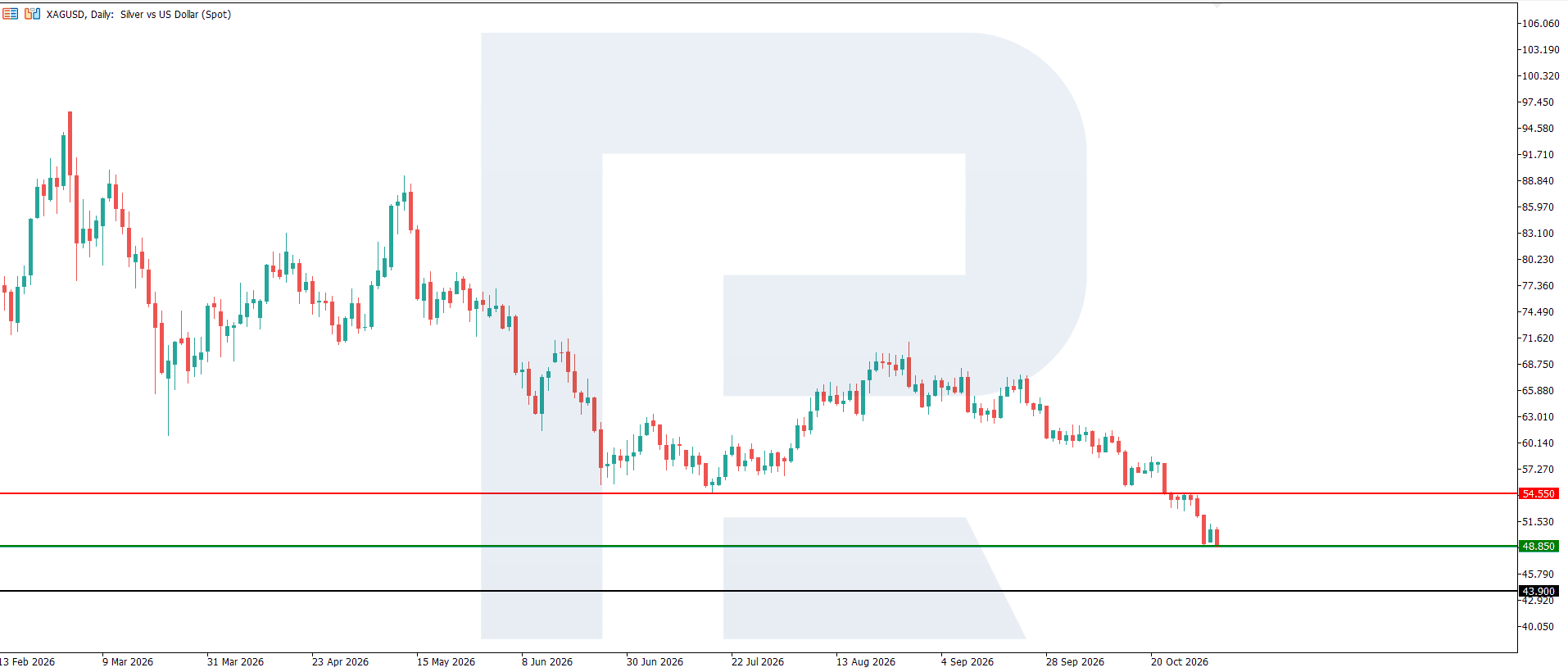
Silver continues to fall: XAGUSD revisits November last year's lows The prospect of further monetary policy tightening is supporting US bond yields and raising the opportunity cost of holding non-interest-bearing precious metals. Prices are currently hovering at 48.94 USD. Technical outlook XAGUSD remains in a downtrend. On the D1 timeframe, a resistance level has formed at 54.55, while support lies at 48.85. Prices have fallen to their November 2025 lows. Before declining further, they may enter a sideways trend. The fundamental outlook for silver remains mixed. Easing inflation concerns, declining real US bond yields. Read more - Silver Forecast Attention! Forecasts presented in this section only reflect the author’s private opinion and should not be considered as guidance for trading. RoboForex bears no responsibility for trading results based on trading recommendations described in these analytical reviews. Sincerely, The RoboForex Team
-
All thanks, appreciation, and respect to you, Mr. kesk, for your continued contributions.👏👏👏🌹 We await Mr. banker2882 to complete the work, and we extend to him our sincere thanks and respect.👏👏👏🌹
-

HFMarkets (hfm.com): Market analysis services.
AllForexnews replied to AllForexnews's topic in Fundamental Analysis
Date: 3rd November 2026. AI Chip Sell-off, Asian Stocks Tumble as NASDAQ Correction Deepens Ahead of US Midterms. Global stock markets are coming under renewed pressure as concerns over artificial intelligence (AI) valuations, corporate earnings, and political uncertainty weigh on investor sentiment. Asian equities are leading the latest decline, while the NASDAQ 100 has entered correction territory following a prolonged sell-off in technology and semiconductor stocks. Investors are increasingly questioning whether the substantial capital being invested in AI infrastructure will deliver the returns needed to justify elevated company valuations. These concerns are emerging at a particularly sensitive time, with the US midterm elections adding another layer of uncertainty to the market outlook. Meanwhile, oil prices remain volatile as investors assess potential peace negotiations between the United States and Iran. Currency markets are also experiencing significant movements following the Reserve Bank of Australia’s latest interest rate decision and intervention by China’s central bank. Asian Stock Markets Decline as Technology Shares Face Selling Pressure Asian stock markets experienced another difficult trading session on Tuesday, 3 November, with technology-heavy indices recording some of the largest losses. The MSCI Asia-Pacific Index excluding Japan declined approximately 1.4%, reaching its lowest level since October 23. South Korea’s KOSPI Index fell by as much as 4.1%, while Taiwan’s benchmark dropped approximately 3.3%. The declines were largely concentrated in semiconductor companies, which have benefited considerably from the expansion of artificial intelligence over recent years. Shares in Samsung Electronics and SK Hynix both declined by more than 4%, reflecting increasing concerns about the sustainability of demand for AI-related technology and the potential profitability of future investments. The weakness follows significant selling pressure in the United States, where semiconductor stocks have fallen approximately 12% over three consecutive sessions. More importantly, the NASDAQ 100 has declined by over 10% from its previous peak, entering what is commonly referred to as a technical correction. A market correction does not necessarily indicate the beginning of a prolonged bearish trend. However, it can signal that investor expectations are changing, particularly when valuations have been supported by strong earnings growth forecasts. Why Are AI and Semiconductor Stocks Declining? The latest market correction is being driven by a combination of factors rather than a single development. Firstly, investors are becoming increasingly selective about AI-related investments. Technology companies continue to commit substantial resources to data centres, advanced semiconductors, and computing infrastructure, but questions remain about how quickly these expenditures will generate meaningful returns. Secondly, elevated valuations have increased the sensitivity of technology stocks to earnings announcements. Even companies reporting revenue growth can experience selling pressure when profit margins, guidance, or investment spending fail to meet expectations. Apple provides a recent example. The company warned of pressure on its gross margins due to rising memory chip costs, contributing to a decline in its share price. Finally, uncertainty surrounding the US midterm elections is encouraging some investors to reduce exposure to higher-risk assets. The combination of these factors is contributing to a broader reassessment of technology stocks, although selling pressure does not necessarily indicate that investors are abandoning the equity market altogether. US Midterm Elections Add to Stock Market Uncertainty The US midterm elections represent another significant event for financial markets, particularly as investors consider the potential implications for fiscal policy, regulation, and government spending. President Donald Trump’s Republican Party faces a challenge in maintaining control of Congress, with opinion polls indicating that Democrats could gain seats. The election outcome could influence future government policies, including taxation, technology regulation, energy production, and trade relations. A divided Congress could make it more difficult for the administration to introduce major legislative changes, potentially limiting certain policy initiatives. Conversely, continued Republican control could provide greater flexibility to pursue the administration’s economic agenda. Both scenarios could influence Treasury yields, the US Dollar, and equity valuations. Historically, US equities have often performed positively in the months following midterm elections, as the removal of political uncertainty can support investor confidence. However, historical performance does not guarantee future results. The current market environment is also being influenced by elevated interest rates, geopolitical tensions, and questions surrounding AI investment returns. Consequently, traders will be monitoring not only the election results but also the market’s initial reaction and whether buying activity returns to the technology sector. Oil Prices Rebound as US-Iran Tensions Continue Oil prices are experiencing considerable volatility as investors attempt to determine whether diplomatic negotiations between the United States and Iran could lead to a reduction in geopolitical tensions. Brent crude fell by more than 7% on Monday following signs that both countries could be willing to pursue negotiations. The possibility of a diplomatic resolution encouraged traders to reassess the geopolitical risk premium incorporated into oil prices. However, the decline was partially reversed during Tuesday’s Asian session, with Brent crude recovering towards $105 per barrel. The rebound followed reports of US military strikes targeting Iran’s Qeshm Island, raising concerns that negotiations may not result in an immediate reduction in hostilities. Why Are Oil Prices Important for the Stock Market? Oil prices can significantly influence inflation expectations, interest rate forecasts, and corporate profitability. A sustained decline in energy prices could ease inflationary pressures, potentially improving the outlook for consumers and businesses. Lower inflation could also reduce the need for restrictive monetary policy. However, a renewed increase in oil prices could have the opposite effect, placing additional pressure on companies through higher operating and transportation costs. For technology stocks, which are particularly sensitive to interest rate expectations, prolonged inflationary pressure could further complicate the recovery. Investors will therefore be monitoring developments in the Middle East closely, particularly any indications of a diplomatic agreement or additional disruptions to energy supplies. Australian Dollar Declines Despite Fifth RBA Interest Rate Hike The Australian Dollar weakened following the Reserve Bank of Australia’s decision to increase interest rates by 25 basis points to 4.85%, their highest level since 2008. The decision marked the central bank’s fifth interest rate increase of 2026, bringing the total tightening this year to 125 basis points. The rate increase was widely anticipated following persistent inflationary pressures. Australia’s annual headline inflation rate reached 4.3% in September, remaining above the central bank’s target range of 2% to 3%. Despite the increase, the Australian Dollar declined by approximately 0.3% against the US Dollar, briefly falling below 0.70. The currency’s decline highlights an important aspect of financial markets: an interest rate increase does not automatically strengthen a currency. In this case, the decision was already largely reflected in market prices, while the central bank’s divided vote suggested that policymakers may be becoming more cautious about further tightening. Six members voted in favour of increasing rates, while three preferred to leave them unchanged. The split has encouraged speculation that the RBA may be approaching the end of its tightening cycle, particularly as higher borrowing costs place additional pressure on households and economic growth. Future Australian Dollar movements will likely depend on incoming inflation data, employment figures and changes in expectations for the RBA’s next policy decisions. Stock Market Outlook: What Should Traders Watch Next? The coming sessions could prove particularly important for global financial markets as several major developments converge. US midterm election results: The composition of Congress could influence expectations for fiscal policy, government spending, and regulation. Unexpected outcomes may trigger volatility in stocks, bonds, and currencies. Technology sector performance: Investors will be monitoring whether the NASDAQ 100 can establish a recovery following its technical correction. Semiconductor stocks may remain particularly sensitive to changes in AI investment expectations. US economic data: Upcoming employment figures, including job openings and nonfarm payrolls, could influence expectations for the Federal Reserve’s interest rate path. Stronger-than-expected data may support Treasury yields and the US Dollar, while weaker figures could raise concerns about economic growth. Oil prices and geopolitical tensions: Any meaningful progress towards a US-Iran agreement could reduce oil’s geopolitical risk premium. However, further military developments or supply disruptions could renew upward pressure on prices. Central bank expectations: Following Australia’s latest interest rate increase, traders will also be monitoring upcoming monetary policy announcements in Europe and changes in global inflation expectations. Can Global Stock Markets Recover? The immediate outlook remains uncertain as investors balance the potential for a recovery against persistent economic and geopolitical risks. Technology stocks may attract renewed buying interest if valuations become more attractive and corporate earnings demonstrate that AI-related investments are delivering sustainable returns. A reduction in geopolitical tensions and lower oil prices could also support market sentiment by easing inflation concerns. However, if investors continue to question AI profitability, or if election results and economic data increase uncertainty, further volatility cannot be ruled out. The key question is whether the recent decline represents a temporary adjustment in market expectations or the beginning of a more prolonged shift away from technology-led growth. For now, market participants are likely to remain sensitive to economic announcements, political developments and changes in investor risk appetite. Key Takeaways Asian equities experience significant losses as AI concerns intensify. South Korea's KOSPI fell by as much as 4.1%, while Taiwan’s benchmark declined approximately 3.3%, reflecting renewed selling pressure in semiconductor and technology stocks. The Nasdaq 100 enters correction territory ahead of the US midterm elections. A decline of more than 10% from its peak highlights growing concerns about technology valuations, AI investment returns, and the potential implications of political uncertainty. Oil prices remain volatile as US-Iran relations influence market sentiment. Brent crude recovered towards $105 after falling more than 7% on Monday, with diplomatic negotiations and ongoing military developments creating uncertainty over future energy prices. Currency markets react to central bank decisions and changing interest rate expectations. The Australian Dollar declined despite the RBA’s fifth interest rate increase of 2026, while the Chinese yuan weakened following measures introduced by the People’s Bank of China to moderate its appreciation. Always trade with strict risk management. Your capital is the single most important aspect of your trading business. Please note that times displayed based on local time zone and are from time of writing this report. Click HERE to access the full HFM Economic calendar. Want to learn to trade and analyse the markets? Join our webinars and get analysis and trading ideas combined with better understanding of how markets work. Click HERE to register for FREE! Click HERE to READ more Market news. Andria Pichidi HFMarkets Disclaimer: This material is provided as a general marketing communication for information purposes only and does not constitute an independent investment research. Nothing in this communication contains, or should be considered as containing, an investment advice or an investment recommendation or a solicitation for the purpose of buying or selling of any financial instrument. All information provided is gathered from reputable sources and any information containing an indication of past performance is not a guarantee or reliable indicator of future performance. Users acknowledge that any investment in Leveraged Products is characterized by a certain degree of uncertainty and that any investment of this nature involves a high level of risk for which the users are solely responsible and liable. We assume no liability for any loss arising from any investment made based on the information provided in this communication. This communication must not be reproduced or further distributed without our prior written permission. -
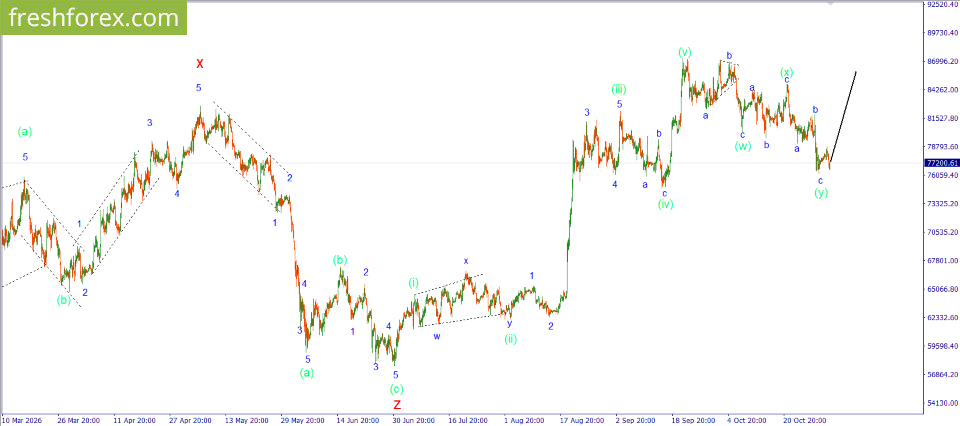
Elliott wave analysis of the market for November 3, 2026 BTCUSD The Freshforex birthday celebration continues! To celebrate our 22nd anniversary, we are offering: Swap-free trading until the end of the month! A 220% drawdown bonus from $220! Double cashback — up to $40 per lot! BTCUSD: BUY 78800, SL 76600, TP 95000. Bitcoin attempted to recover its price, but the move was not very successful. The resulting movement was quickly liquidated. However, the situation remains quite favorable for a general price increase. This is due to the possible completion of a correction in the form of a double zigzag. A rise is expected in this scenario as an upward impulse in the next phase of market development. It is quite possible that we will see another attempt to start rising during today's session. You can try cautiously buying on a breakout of yesterday's local extreme. Investment idea: BUY 78800, SL 76600, TP 95000. Up to $20 per lot with real funds - get guaranteed income by joining the promotion Cashback! You can find more analytical information on our website.
-
When you have the latest Terra program, why worry about TSA?
-

VIP Membership - FREE upgrade for OLD and ACTIVE Members
Polako replied to MrAdmin's topic in Announcements
Hello @Traderbeauty, I have been a member since August 2026 and would like to become a VIP; how should I proceed? -
 Many brokerage operators focus heavily on feature lists when selecting a CRM system, yet overlook long‑term technical support. A professional‑grade brokerage CRM is more than client registration, KYC workflows, IB commission settlement and MT5 integration. It connects client portals, admin back‑office and core business API layers, forming a closed‑loop capital workflow based on the central cash wallet. During business expansion, brokers will face real challenges: system configuration adjustments, permission management, multi‑language deployment, troubleshooting for deposit‑withdrawal orders, and continuous iteration for risk‑control rules. Without reliable ongoing technical support, even a full‑featured system can create operational bottlenecks. When evaluating CRM solutions, apart from functions and compatibility, it is critical to review response efficiency, audit‑log traceability, upgrade mechanisms and maintenance services. The right CRM plus stable technical support helps your team focus on core brokerage business, rather than resolving system issues. If you are reviewing or upgrading your MT5 brokerage technical stack, feel free to share your current operational pain points for open discussion.
-

VIP Membership - FREE upgrade for OLD and ACTIVE Members
⭐ Nguyennguyen replied to MrAdmin's topic in Announcements
Please make me a VIP. @Traderbeauty - Yesterday
-

VIP Membership - FREE upgrade for OLD and ACTIVE Members
⭐ Denis replied to MrAdmin's topic in Announcements
hello @Traderbeauty, I submitted a few requests through the "Contact Us" link regarding VIP role access, but haven't received an update yet. I’ve been a member since June 2025 and would greatly appreciate it if you could assist in granting VIP status to my account. Thank you for your time and help, Denis -

VIP Membership - FREE upgrade for OLD and ACTIVE Members
⭐ Boka replied to MrAdmin's topic in Announcements
Can you please add me to VIP -
HFMarkets (hfm.com): Market analysis services.
AllForexnews replied to AllForexnews's topic in Fundamental Analysis
Date: 2nd November 2026. US Midterm Elections 2026: Will Stock Markets Rally or Fall? The US midterm elections take place on Tuesday, 3 November, and investors are preparing for potential volatility across global financial markets. With control of Congress at stake, the outcome could influence government spending, regulation, and economic policy during the remainder of President Trump’s term. However, historical data suggests that elections do not necessarily determine the longer-term direction of stock markets. In fact, the S&P 500 has demonstrated a remarkably consistent pattern of gains following previous midterm elections. Could 2026 be different? The S&P 500’s Remarkable Midterm Election Record Since 1950, the S&P 500 has recorded positive returns in the 12 months following every US midterm election, with an average gain of approximately 15%, according to JPMorgan Asset Management. The six-month performance has also been historically positive, partly because political uncertainty tends to ease once election results become clear. Investors generally dislike uncertainty surrounding taxation, government spending, and regulation. Once the political landscape becomes clearer, attention often shifts back towards corporate earnings, economic growth, and monetary policy. However, historical performance does not guarantee future returns, particularly when market conditions differ significantly from previous election cycles. Why the 2026 Elections Could Be Different There are several reasons why this year’s elections could have a different impact on financial markets. Firstly, US stock valuations are unusually elevated. The S&P 500’s cyclically adjusted price-to-earnings ratio currently stands near 40.7, substantially above its historical average of approximately 20. Secondly, technology stocks have experienced significant selling pressure as investors question whether substantial investments in artificial intelligence will generate sufficient profits. The NASDAQ 100 declined 3.5% on Friday, while the Philadelphia Semiconductor Index lost 7.2%, highlighting the vulnerability of technology companies to changing investor expectations. Finally, geopolitical tensions involving Iran have pushed oil prices higher, increasing inflationary pressures and complicating the Federal Reserve’s monetary policy outlook. These factors suggest that economic fundamentals could have a greater influence on stock market performance than the election results themselves. How Could the Election Results Affect Financial Markets? The composition of Congress could influence investor expectations regarding future economic policies. A divided Congress, where political control is shared between Republicans and Democrats, could make major legislative changes more difficult. Historically, this has sometimes coincided with stronger stock market performance because it reduces the likelihood of substantial policy shifts. Alternatively, Democratic control of both chambers could result in greater legislative and regulatory scrutiny of the administration’s policies, potentially influencing government spending, technology companies, and the energy sector. However, the relationship between political control and stock market performance is far from straightforward. Economic growth, corporate profitability, and monetary policy have historically played a more significant role in determining longer-term market trends. What Could Happen to Gold, the Dollar and Oil? The election results could influence several major financial assets, particularly if the outcome differs from market expectations. Gold: Increased political uncertainty or a deterioration in risk appetite could support demand for safe-haven assets. However, higher Treasury yields and expectations of further Federal Reserve rate hikes could limit Gold’s potential gains. US Dollar: The Dollar could react to changes in Treasury yields, fiscal policy expectations, and investor risk appetite. The direction will depend on how markets interpret the election outcome and its implications for economic growth. Oil: Energy prices could remain particularly sensitive to developments involving Iran. Investors will be monitoring whether US foreign policy changes following the elections increase or reduce geopolitical risks. US Stock Indices: The S&P 500 and NASDAQ 100 could experience increased volatility as investors reassess fiscal policy, AI regulation, and the broader economic outlook. Importantly, these reactions are not guaranteed. Markets may have already priced in some potential election outcomes, reducing the impact of the actual results. Market Outlook: Will History Repeat Itself? The US midterm elections arrive at a challenging time for financial markets. Although historical trends suggest that equities often strengthen after midterm elections, elevated valuations, persistent inflation risks and uncertainty surrounding AI investments could challenge this pattern. Investors will also be monitoring Friday's US Non-Farm Payrolls report, which could influence expectations for the Federal Reserve's December interest rate decision. Ultimately, the elections could trigger short-term volatility, but the sustainability of any market rally will likely depend on corporate earnings, inflation, interest rates and geopolitical developments. For traders, the important consideration is not simply which party controls Congress, but how the outcome changes market expectations and whether those changes are reflected in asset prices. Always trade with strict risk management. Your capital is the single most important aspect of your trading business. Please note that times displayed based on local time zone and are from time of writing this report. Click HERE to access the full HFM Economic calendar. Want to learn to trade and analyse the markets? Join our webinars and get analysis and trading ideas combined with better understanding of how markets work. Click HERE to register for FREE! Click HERE to READ more Market news. Andria Pichidi HFMarkets Disclaimer: This material is provided as a general marketing communication for information purposes only and does not constitute an independent investment research. Nothing in this communication contains, or should be considered as containing, an investment advice or an investment recommendation or a solicitation for the purpose of buying or selling of any financial instrument. All information provided is gathered from reputable sources and any information containing an indication of past performance is not a guarantee or reliable indicator of future performance. Users acknowledge that any investment in Leveraged Products is characterized by a certain degree of uncertainty and that any investment of this nature involves a high level of risk for which the users are solely responsible and liable. We assume no liability for any loss arising from any investment made based on the information provided in this communication. This communication must not be reproduced or further distributed without our prior written permission. -
Thanks kesk for your regular updates.🌹❤️